
ZESTLET · OEM / ODM · Private Label
Kilt Skirt Problems: Waist Fit, Apron, Pleats and Tartan – and How to Avoid Them
Build Now, Pay Later · New brands welcome
Launch your brand from 20 pieces. Pay the balance after your stock arrives.
ZESTLET makes your tactical, hunting, uniform and Highland products under your own label. Your first sample and branding setup are free, and orders from $5,000 can pay 60% after delivery.
Budget under $5,000
Startup Launch
- Start from 20 pieces per product
- Your first sample is free
- Labels, screens and digitising are free
- Bulk starts only after you approve the sample
Orders from $5,000
Build Now, Pay Later
- Pay 40% to start production
- Pay the other 60% monthly after delivery
- No interest and no application fee
- Your limit grows with every on-time payment
Your full journey with ZESTLET, step by step
From your first idea to stock in your warehouse. Every step is visible in your free brand dashboard.
- 1Create your free brand accountSign up in about one minute. We email you a 6-digit code to confirm your account.
- 2Check your credit in 30 secondsAnswer 3 short questions in your dashboard and see your pre-qualified credit limit straight away.
- 3Start your projectUpload your design or tech pack, choose the product and quantity. You can start from 20 pieces per product.
- 4Get your quotation within 24 hoursPrice per piece, lead time and payment terms in writing, from real people in Sialkot.
- 5Free sample with your brandingWe make your sample with your logo in 7–10 working days. You only pay the sample shipping.
- 6Approve and pay 40%Bulk production starts only after you approve the sample and pay the 40% deposit.
- 7Production and quality checksCutting, stitching, inspection and packing, with progress updates in your dashboard.
- 8Delivery, then pay 60% monthlyDoor-to-door shipping. Credit orders pay the balance after delivery over 90 to 365 days, with no interest.
What you need to apply
- Your brand name and contact details
- Your product idea, design or tech pack
- An order value from $5,000 for Build Now, Pay Later
- For higher limits: sales history or business registration
Your credit limit grows with you
First credit order
After 2 orders paid on time
After 4 cycles and a review
- Deposit
- 40%
- Balance after delivery
- 60%, monthly
- Repayment
- 90 to 365 days
- Interest and fees
- None
Can I start a clothing brand with a small budget?
Yes. You can start from 20 pieces per product, and your first sample and branding setup are free, so your budget goes into product.
Who can use Build Now, Pay Later?
Brands with orders from $5,000, including new brands with no sales history, after a short review. You pay 40% upfront and 60% in monthly instalments after delivery.
Is the sample free?
Yes, the first sample is made free with your branding. Sample shipping is paid by the buyer.
Credit is subject to approval. Amounts shown in your local currency are approximate.
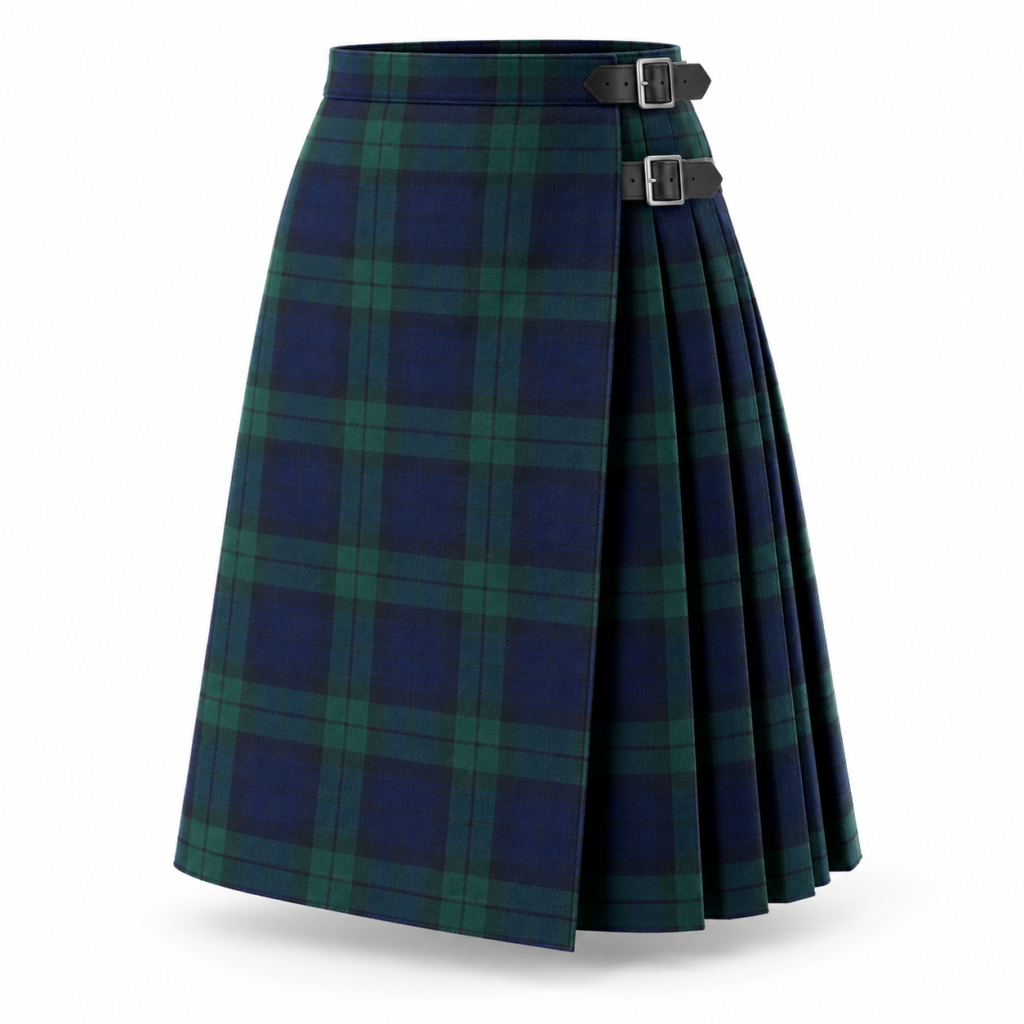
A kilt skirt looks simple on a hanger: a wrapped tartan skirt with a flat apron at the front, pleats at the back and a fastening at the side. In practice it is one of the easier Highland products to get wrong. It has to fit a women’s waist and hip shape, hang at the right length, place the tartan correctly on the apron and keep its pleats after wearing and pressing.
This article is for Highland outfitters, retailers, band suppliers and brand owners who sell or plan to sell kilt skirts. It covers the problems buyers meet most often and how to prevent them before a production order.
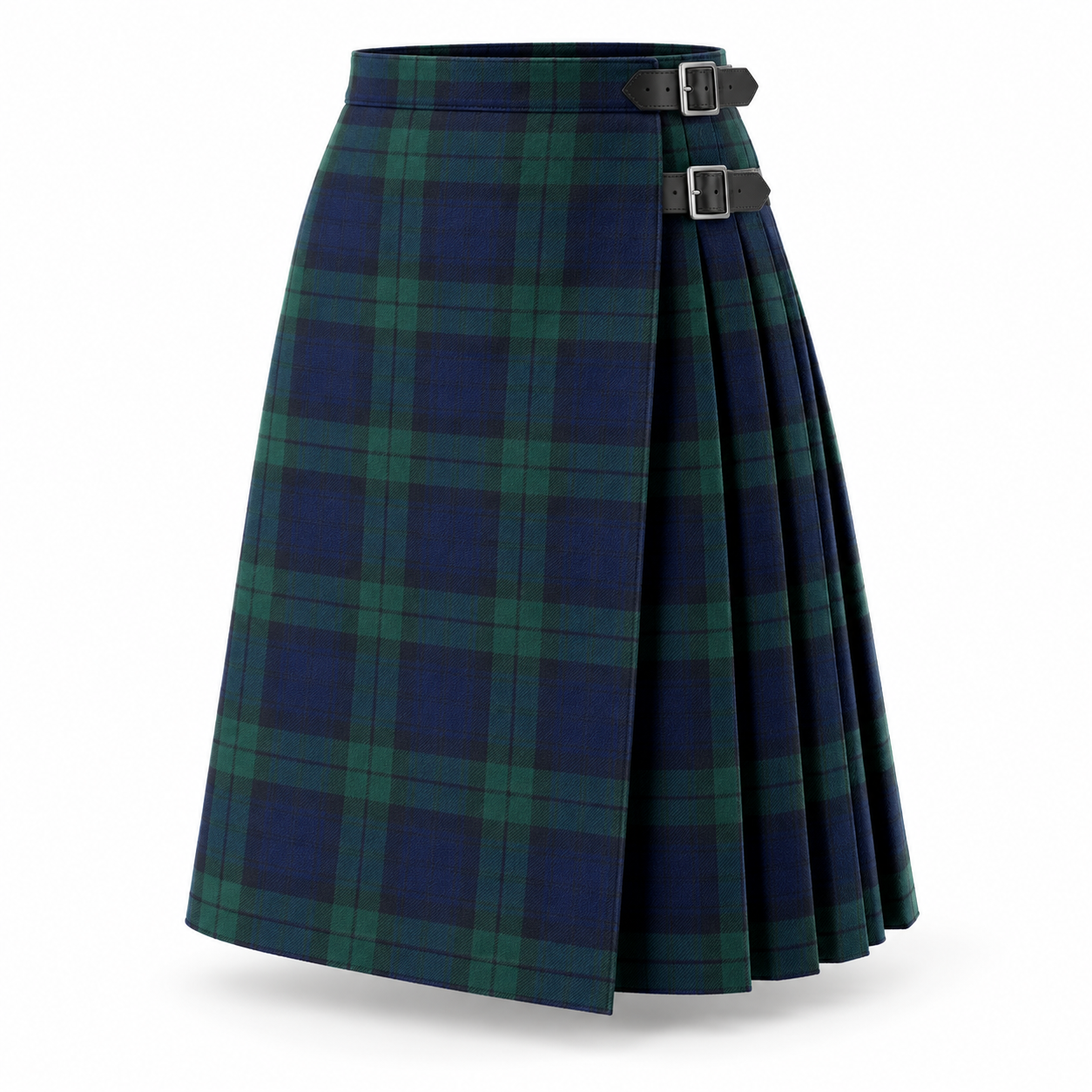
1. A men’s kilt pattern with a new label
The most common shortcut is to take a men’s kilt pattern, shorten it and call it a kilt skirt. A men’s kilt is built around a different waist-to-seat relation and is often worn at a different level. The result is a skirt that gaps at the waist, pulls across the hip or swings open at the apron.
How to avoid it: develop the kilt skirt from a women’s skirt block, based on the intended waist level, the fullest hip and the ease you want. Approve that block on a fitted sample before any tartan is cut for bulk.
2. Tight straps used to hide a shaping problem
When the difference between waist and hip is large, a straight-cut wrap stands away from the waist. Tightening the straps hides this for a moment, but it pulls the apron sideways and distorts the pleats. A high hip-to-waist difference needs pattern shaping, not just tighter straps.
How to avoid it: build the shaping into the pleats and the apron during pattern making. Check the sample standing, walking and sitting with the straps at a normal setting.
3. An apron that opens or rides up
The apron is the flat front panel, with the under-apron behind it. If the overlap is too small, the skirt opens when the wearer walks or sits. If the edge finish is weak, or a fringed edge is unbalanced, the front looks untidy even when the fit is right.
How to avoid it: specify the apron overlap, front alignment and edge finish in the drawing, and judge them on the finished sample, not on a digital rendering.
4. A length that changes between sample and bulk
A kilt skirt can be worn at the knee, below the knee or longer for evening wear. Problems start when length is not tied to a fixed waist reference: one person measures from the top edge, another from the natural waist, and the bulk order comes out shorter or longer than the sample.
How to avoid it: state the finished length from the agreed waist reference, with a tolerance. Also check how the tartan sits at the hem at that length, because a change in length can put a strong line of the sett in an awkward place.
5. Tartan that does not line up
Tartan is a repeating pattern called the sett. On a kilt skirt the eye goes straight to the apron and the pleats. A sett that is off-centre on the apron, or pleats that show a different stripe from one size to the next, looks like poor quality even when the sewing is good.
How to avoid it: agree the sett scale, which part of the sett is centred on the apron, and whether the pleats are made to the stripe or to the sett. Approve the cloth by swatch and keep that swatch as the reference for bulk.
6. Pleats that lose their shape
Pleat placement, depth, press and stitch-down length decide how the back of the skirt moves. Pleats stitched down too short can open over the hip; pleats stitched too long make the skirt stiff when walking.
How to avoid it: write pleat depth and stitch-down length into the specification, and check that the pleats hold after a test wear and after the care method you plan to recommend.
7. Lining, opacity and comfort
Some tartan cloths work well without lining. Lighter or more open cloths can feel scratchy or look thin against the light. On the other hand, a heavy lining can spoil the swing of the pleats.
How to avoid it: decide lining coverage and material on the sample, considering cloth handle, opacity, comfort and how the skirt will be worn.
8. Sizes that do not grade well
A sample can fit perfectly in one size while the smaller and larger sizes fail, often because waist and hip were graded by the same steps without thinking about the figure.
How to avoid it: agree a grading rule that keeps the waist/hip relation sensible across the size range, and check the smallest and largest sizes as well as the base size.
Checklist before you approve a kilt skirt sample
| Point | What to check |
|---|---|
| Waist | Sits at the agreed wearing level without gaping or pulling |
| Hip | Enough ease at the fullest hip; apron stays flat |
| Apron | Overlap holds when walking and sitting; neat edge finish |
| Pleats | Agreed depth, stitch-down length and press |
| Length | Measured from the agreed waist reference; hem balanced in the sett |
| Tartan | Sett placed on the apron as agreed; matches the approved swatch |
| Closure | Straps, buckles or concealed fastening work without pulling the apron |
| Care | Care method validated on the sample cloth |
For cloth, length, lining and sizing choices, read our kilt skirt buyer’s guide. To see how each point is controlled in production, read how a kilt skirt is made. For men’s kilts, see common kilt problems and how to fix them.
Develop your kilt skirt with ZESTLET
ZESTLET in Sialkot, Pakistan makes Highland wear for outfitters, retailers, band suppliers and private-label brands.
- Kilt skirts developed from a women’s block, not a relabeled men’s kilt
- Wool, wool-blend or alternative tartan selected by swatch
- Small batches, always with a sample first
- Private label with your own labels and packaging brief
See the kilt skirt or request a quote with your measurements, cloth and styling reference.
Frequently asked questions
Why does my kilt skirt gap at the waist?
Usually because the pattern was not shaped for the waist-to-hip difference of the wearer. The fix is pattern shaping in the pleats and apron, not tighter straps.
Can a men’s kilt pattern be used for a kilt skirt?
It is not recommended. A women’s kilt skirt should be developed from the intended waist and hip fit rather than relabeling a men’s kilt pattern.
How do I stop the apron from opening?
Specify enough apron overlap and check it on the finished sample while walking and sitting. The closure position also affects how well the apron stays closed.
Why do the pleats look different between sizes?
The pleating rule (to the stripe or to the sett) and the sett placement were not fixed for every size. Agree them in the specification and check more than one size.
Does a kilt skirt always need a lining?
No. It depends on cloth handle, opacity, comfort and use. Decide lining material and coverage on the sample.