
ZESTLET · OEM / ODM · Private Label
Custom Sportswear Manufacturer Guide: Activewear Fabrics, Construction and Production
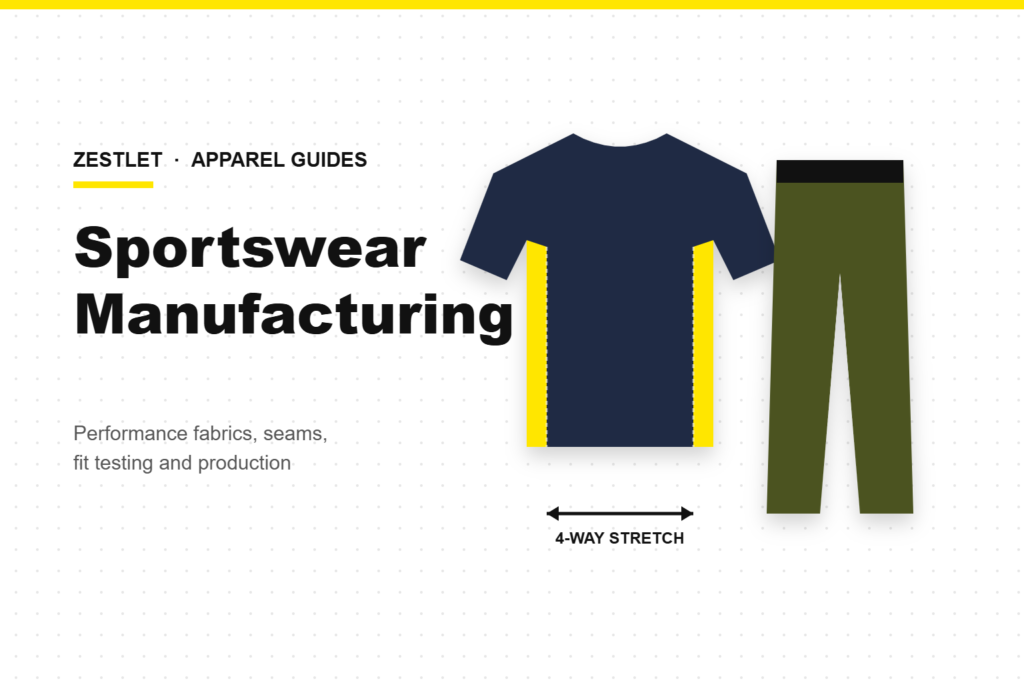
Sportswear is judged in movement. A training top has to stretch without losing shape, leggings must stay opaque when the wearer squats, and seams cannot chafe after an hour of running. Working with a sportswear manufacturer therefore means specifying how the garment should perform, not only how it should look, and proving it on samples before bulk production.
This guide explains how to choose performance fabrics, which construction methods suit activewear, how to test fit and function, which decoration methods work on technical fabrics, and how a custom or private label sportswear order is organised.
What a sportswear manufacturer makes
Sportswear and activewear cover a wide range of products, and each family has its own priorities:
| Product family | Main priorities |
|---|---|
| Training tops and tees | Breathable knit, comfortable seams, shape retention after washing |
| Leggings and tights | Opacity, stretch and recovery, waistband that stays in place, gusset comfort |
| Shorts | Freedom of movement, liner or inner brief, secure pockets |
| Team kits and jerseys | Full-colour graphics, names and numbers, consistent sizing across a squad |
| Hoodies, track tops and joggers | Brushed or textured knits, zips and cuffs that survive frequent use |
| Base layers and compression | Close fit, flat seams, stretch that recovers fully |
Tell your manufacturer the sport or activity, the climate and how often the garment will be washed. These answers decide the fabric and construction far more than the sketch does.
Choose the right performance fabric
Most sportswear uses synthetic knits blended with elastane, because they stretch, recover and dry faster than cotton.
| Fabric | Character | Typical use |
|---|---|---|
| Polyester / elastane jersey or interlock | Lightweight, quick drying, takes sublimation printing | Training tops, team jerseys |
| Nylon / elastane | Smooth, strong, soft hand-feel, good stretch | Leggings, sports bras, compression wear |
| Mesh knits | Open structure for ventilation | Side and back panels, linings |
| Brushed-back or fleece knits | Soft, warmer inner face | Hoodies, joggers, cold-weather layers |
| Recycled polyester | Similar performance to virgin polyester | Ranges with a sustainability claim |
Specify composition, knit type, weight, stretch direction (two-way or four-way) and the finish you need. Fabrics are often sold as moisture-wicking, anti-odour or UV-protective; if those claims will appear on your swing tags or website, ask for test reports on the exact fabric and keep them on file. Recycled content claims also need supporting documentation. Our fabric sourcing guide covers the approval steps.
Construction methods for activewear
Activewear seams must stretch with the fabric and sit flat against the skin. The common methods are:
- Flatlock seams: fabric edges butt together and are stitched flat, giving a smooth, low-bulk seam for tights and base layers.
- Overlock with coverstitch: a strong, stretchable seam used on many tops and shorts; the coverstitch keeps it flat.
- Bonded or laser-cut edges: seams and hems joined with adhesive tape for a clean, minimal finish on premium pieces.
- Gussets: a diamond or triangular panel at the crotch of leggings and shorts for movement and comfort.
- Waistbands: wide, double-layer or elastic-enclosed bands that stay in place during movement, sometimes with a hidden key pocket.
Use stretch thread suited to the fabric and test that stitches do not crack when the seam is pulled. Reflective trims, zip garages, thumbholes and drawcord channels should all be shown in the tech pack with exact positions.
Fit and function testing
Sportswear fit must be checked on a moving body, not only on a table.
- Movement test: squat, lunge, reach and run in the sample. Check that waistbands stay up, hems do not ride and seams do not dig in.
- Opacity test: stretch leggings over the knee or squat in good light to make sure the fabric is not see-through.
- Recovery: after stretching and washing, the garment should return to its original measurements.
- Wash test: check shrinkage, colour bleeding and print durability before approving bulk.
Grade sizes only after the base size passes these checks. For team orders, sending a size set to a few players before bulk production helps avoid a whole squad receiving the wrong fit.
Decoration on technical fabrics
| Method | Best for | Consider |
|---|---|---|
| Sublimation | All-over and full-colour designs on light polyester | Needs polyester-rich, light-coloured fabric |
| Heat transfer | Logos, names and numbers | Choose stretch transfers so they flex with the fabric |
| Silicone or high-density print | Raised logos, grip details | Check adhesion after repeated washing |
| Embroidery | Small logos on heavier knits | Can stiffen light, stretchy fabrics |
Approve a decorated sample on the actual fabric and colour, then wash-test it. See embroidery and patches for badge and logo options.
How a custom sportswear order runs
- Brief: product family, activity, target market, fabric preferences, sizes and quantities.
- Tech pack and materials: measurements, construction, fabric and trim approvals.
- Proto and fit samples: movement, opacity and wash tests; corrections agreed.
- Pre-production sample: final fabric, decoration, labels and packing.
- Bulk production and inspection: in-line and final checks against the approved sample. See quality control and inspection.
Order quantities depend on fabric and colour minimums, so plan a focused colour range for a first collection. Read clothing MOQ explained and small batch manufacturing if you are starting small.
Common sportswear mistakes
- Approving leggings without an opacity test. Sheer fabric is one of the most common returns.
- Rigid seams on stretch fabric. Seams must stretch as much as the garment.
- Performance claims without evidence. Only state wicking, UV or anti-odour benefits that are supported by tests.
- Sublimation on dark or cotton-rich fabric. It needs light polyester to work.
- Grading before fit approval. Fix the base size first.
Frequently asked questions
What fabric is best for activewear?
Polyester or nylon blended with elastane suits most activewear. Polyester is lighter and works with sublimation; nylon feels smoother and is popular for leggings. Choose by activity, climate and budget.
What is the difference between sportswear and activewear?
The terms overlap. Sportswear often refers to team kits and sport-specific clothing, while activewear covers training, gym and lifestyle pieces worn both for exercise and casually.
Can I make private label activewear in small quantities?
Yes, but fabric and colour minimums affect the price. A small range in fewer colours keeps the order practical. Ask for the minimums per colour before you finalise the range.
How do I stop leggings from being see-through?
Choose a dense knit with suitable weight and stretch, and run a squat test on the sample. Darker colours and a gusset also help.
Does ZESTLET manufacture sportswear?
Yes. ZESTLET produces custom and private label sportswear, training wear and base layers, including tactical and outdoor performance pieces such as our thermal base layer top. Samples are approved before bulk production.
Related guidance
This guide is original ZESTLET editorial content based on apparel development practice. Continue with the custom T-shirt manufacturer guide, clothing label requirements and choosing a clothing manufacturer.