ZESTLET · OEM / ODM · Private Label
Private Label Clothing: Development, Branding and Buyer Approvals
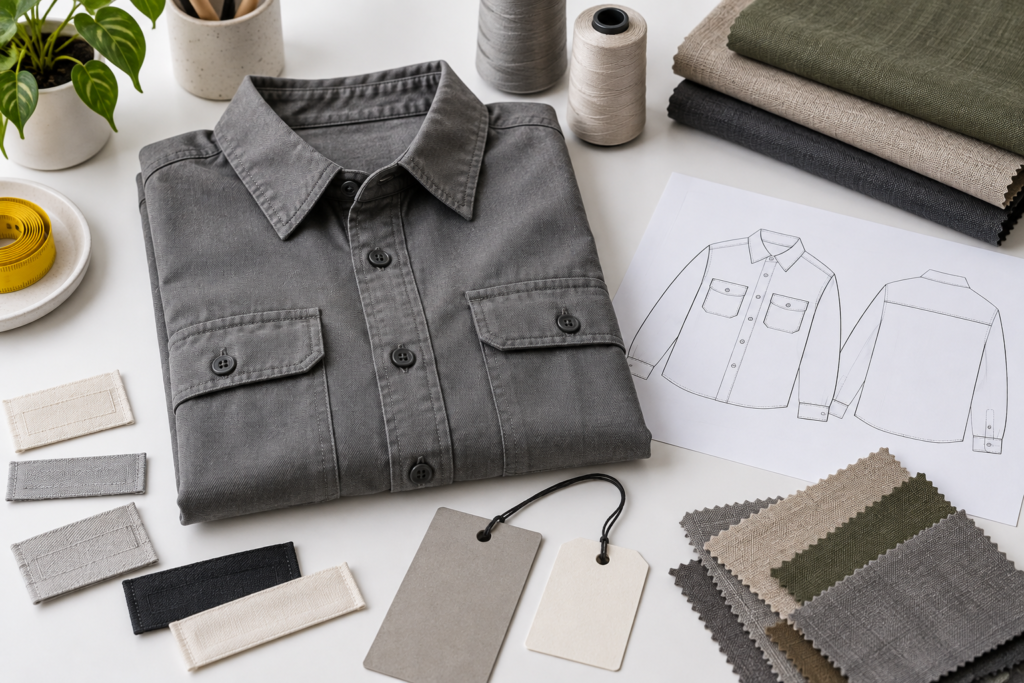
Private label clothing is apparel supplied for sale under the buyer’s brand. The phrase does not, by itself, tell you how much of the design is original, who owns the pattern or whether another buyer can order a similar garment. Define the development and supply arrangement before treating a label change as a complete brand product.
This guide helps brands distinguish branding work from garment development and build an approval brief that covers both. It focuses on questions to resolve with the actual supplier rather than promising one universal private label model.
Start with the product route
Ask whether you are selecting an existing garment, modifying an established construction or developing a new design. These routes involve different decisions. An existing blank may need only artwork and packing approvals; a new lined jacket may require patterns, fabric review, fit samples and several component decisions.
Terms such as private label, white label, OEM and custom manufacturing can be used differently between suppliers. Describe the work you need in plain language. Ask for a written breakdown rather than relying on the term in a website headline.
| Work area | Decision to record | Evidence to approve |
|---|---|---|
| Garment | Existing style, modification or new development | Drawing, measurements and accepted sample |
| Materials | Approved fabrics, closures, thread and trims | Material references and sample assembly |
| Brand identity | Authorized artwork and label placement | Artwork proof and physical application |
| Commercial scope | Minimums, development work and order terms | Project-specific quotation and agreement |
| Repeat orders | File access and component substitutions | Controlled specification and approval record |
Write the brand brief alongside the garment brief
Supply the logo source files you are authorized to use, intended dimensions, color references and placement. Show brand labels, care information, size identification, hangtags and packing labels separately. Each serves a different purpose, and a decorative brand label should not obscure information required for the destination market.
Keep spelling, item codes and barcode information under one approval process. A garment can be correctly made and still be difficult to receive or sell if the packaging identifies the wrong size or variant. Include a packing schedule that connects the physical garment to the order record.
Confirm design and pattern responsibilities
Ask who prepares drawings, patterns, grading and artwork adaptations. Establish which deliverables you receive and which files remain part of the supplier’s internal process. If you need exclusivity or the right to move production, address those points explicitly in appropriate agreements.
A brand name on a product is not evidence of exclusive ownership of every underlying design feature. Similarly, a reference image does not grant permission to reproduce another company’s proprietary artwork. Identify the rights and responsibilities before development rather than trying to resolve them after a successful launch.
Approve materials in the finished garment
Evaluate the proposed material with the intended construction and decoration. A fabric swatch alone does not show how an embroidered logo will affect the garment or how a closure behaves when assembled. Request the sample evidence needed for the particular decision.
When a component is unavailable, ask for a clearly identified alternative. Record what changes in appearance, handle, dimensions, care behavior and timing. Do not allow a similar name or color to stand in for approval of the actual substitute.
Separate the approval stages
- Brief review: settle the development route, quantities, destination and open decisions.
- Design review: confirm drawings, dimensions and authorized artwork.
- Material review: approve the actual references or mark temporary substitutes.
- Sample review: check fit, construction, branding and packing in the intended context.
- Order release: reconcile the accepted sample, current specification and commercial terms.
- Repeat-order review: confirm availability and approve any changes before production.
A digital logo proof is not the same as a finished branding sample. Likewise, a first prototype may answer a fit question without approving every trim. Write the scope of each approval so the factory knows what may proceed and what remains pending.
A practical range-planning example
Imagine a brand developing a shirt and a lightweight jacket. It wants matching woven labels and hangtags, but different size labels and care instructions. Combining all of these under “same branding” can cause the wrong information to be applied to one garment.
Create shared references for the truly shared components, then separate references for product-specific information. Review both garments with their own complete label sets. The example is hypothetical; its purpose is to show why coordinated branding still needs item-level control.
Compare supplier proposals against the same scope
Ask each supplier to identify included development, materials, decoration, packing and delivery terms. Confirm whether sample work or setup charges are separate and what the quoted minimum applies to. A proposal for branding a stock garment cannot be compared directly with one for a newly developed style.
Public manufacturer service descriptions can help you identify possible routes, but they do not establish your project’s final terms. For example, Qadri Sports describes private label and OEM apparel services; that is a supplier’s own service statement, not evidence of a relationship with ZESTLET or a transferable promise about minimums or schedules.
Private label clothing questions
Does private label automatically mean an exclusive design?
No. Agree the design route and any exclusivity separately. Clarify pattern ownership, artwork rights and repeat-order access in the project documentation.
Can I request only labels and packaging?
Describe that scope clearly and ask whether it is available for the garment you intend to use. Do not assume every manufacturer offers relabeling of third-party garments.
What should I send ZESTLET?
Send the product type, design references, quantity breakdown, destination and authorized branding files through our private label manufacturing service. Exact materials, development scope, minimums and timing are confirmed for the project.
Sources and related reading
Background supplier example: Qadri Sports’ private label manufacturing FAQ. The approval framework and example are original ZESTLET editorial guidance. Read our tech pack guide, MOQ guide and labels and packaging overview.