ZESTLET · OEM / ODM · Private Label
Clothing Label Requirements: US, UK and EU Guide for Private Label Brands
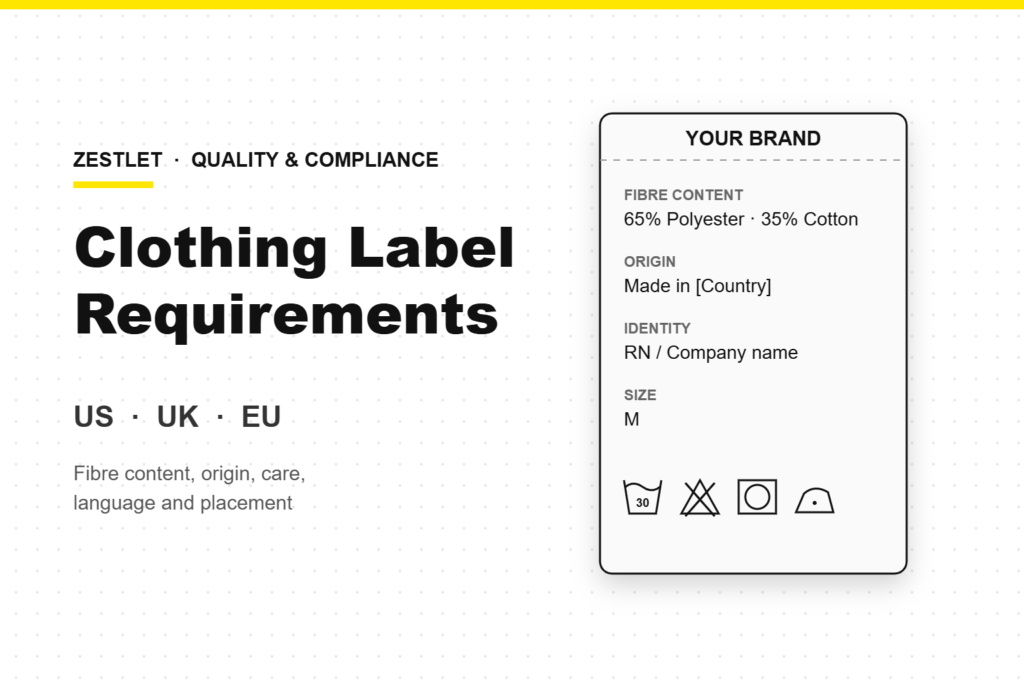
Clothing label requirements depend on where the garment is sold, not where it is sewn. A shirt made in Sialkot for a US brand needs a label that satisfies US rules; the same shirt sold in Germany or the UK needs a label built for those markets. For a private label brand, the label is a legal disclosure as well as a branding piece, and it has to be correct before bulk production starts, because a sewn-in label cannot be fixed after packing.
This guide explains what the main rules in the United States, Great Britain and the European Union ask a garment label to show, how to plan one label for several markets, and what information your manufacturer needs from you. It is practical planning guidance, not legal advice. Confirm the final wording with the rules that apply to your sales channel, or with a compliance adviser, before approving artwork.
What a clothing label has to answer
Across the three markets, the required information falls into a small number of questions. Each market answers them differently, which is why a label copied from another brand or another country is a common source of problems.
| Question | United States | Great Britain | European Union |
|---|---|---|---|
| What is it made of? | Required: generic fiber names and percentages by weight | Required: approved fibre names and percentages | Required: approved fibre names and percentages |
| Where was it made? | Required: country of origin | Not required by the textile labelling rules, but must not mislead | No general EU-wide requirement in the textile labelling regulation |
| Who is responsible? | Required: company name or RN number | Manufacturer or UK importer is responsible for the fibre label | The business placing the product on the market is responsible |
| How do I care for it? | Required: permanent care label | Not required by the textile labelling rules; widely expected by retailers | Not harmonised at EU level; widely expected by retailers |
| Which language? | English | English | Official language(s) of each country where it is sold |
United States: Textile Act and Care Labeling Rule
For apparel sold in the US, the Federal Trade Commission’s textile and wool labelling rules require three core disclosures: fiber content, country of origin and the identity of the manufacturer or dealer. A separate FTC rule covers care instructions.
Fiber content
List each fiber by its generic name and percentage by weight, from the largest to the smallest. A single-fiber garment may say “100%” or “All”, for example “All Cotton”. Fibers below 5% are normally grouped as “other fiber” or “other fibers”. Two important exceptions: wool must always be named, and a fiber under 5% may be named when it has a functional purpose, such as spandex for stretch.
Trademarked fiber names may appear only next to the generic name and in the same size and style. Buttons, zips and other non-fibrous parts are not counted. Where sections of a garment use different fabrics, such as a body, lining and contrast panel, each section can be disclosed separately. The FTC allows a 3% tolerance on stated percentages, but no tolerance on a single-fiber claim such as “100% Cotton”, so the fabric test or mill certificate behind the label matters.
Country of origin and placement
Imported garments must name the country where they were manufactured, written in English, for example “Made in Pakistan”. A broad region is not enough. “Made in USA” is reserved for products made in the US from US materials; a garment sewn in the US from imported fabric needs a qualified statement.
Placement is specific. For garments with a neck, the country of origin must appear on the front of a label at the inside centre of the neck, or next to another neck label. Fiber content and the company identity may sit on the same label or on another accessible label. For trousers and skirts, an inside waistband label is the usual position. US Customs rules on origin marking apply in addition to FTC rules.
Identity: company name or RN
The label must show the full business name of the responsible company or its Registered Identification Number, written as “RN” followed by the number. A brand name alone does not satisfy this unless it is also the business name. Many private label brands register an RN so the same label can be used across factories.
Care instructions
The FTC Care Labeling Rule requires a permanently attached care label on textile apparel that explains regular care: washing, drying, ironing, bleaching and any warnings. Care symbols from the ASTM D5489 standard can be used in place of words; other symbol systems need accompanying text for the US market. The instructions must be suitable for the actual garment, so base them on the fabric, trims and print rather than copying a generic set.
In 2025, an industry association petitioned the FTC to allow digital care labels such as QR codes. As of early 2026, the rule had not been changed, so plan for a physical care label and check the FTC’s current position before relying on a digital alternative.
Great Britain: fibre composition in English
In England, Scotland and Wales, the Textile Products (Labelling and Fibre Composition) Regulations 2012 and the assimilated version of EU Regulation 1007/2011 set the rules. The label must state the fibre composition using approved fibre names and percentages, in English.
Where a garment has separate components, such as a lined jacket, the composition of each component must be shown. Decorative parts making up no more than 7% of the product can be excluded. If the garment contains non-textile parts of animal origin, such as leather trims, fur or bone buttons, the label must carry the wording “contains non-textile parts of animal origin”.
The fibre information also has to be visible before purchase when a customer buys from a catalogue or website, so product listings need the same composition as the sewn label. The manufacturer, or the importer bringing the goods into the UK, is responsible for making sure the label is present and accurate. Northern Ireland follows different arrangements, so check separately before shipping there.
European Union: Regulation 1007/2011
The EU Textile Labelling Regulation requires fibre composition labels using the fibre names listed in the regulation, with the same “contains non-textile parts of animal origin” statement where relevant. Labels must be durable, legible, visible and accessible, and composition must be shown to the buyer before purchase, including online.
The language requirement is the one that most often catches brands out. The label must be in the official language or languages of each member state where the product is made available to consumers. A garment sold in France, Germany and Italy therefore needs the composition in French, German and Italian, which is why EU labels often become multi-page booklets.
The regulation does not set a general EU-wide requirement for care labels or country of origin. Most retailers still expect care information, usually as symbols, and origin claims must never mislead. The regulation is under review: in mid-2026, industry groups were still calling on the European Commission to bring forward a revision that could allow some information to move to digital labels. Until a new rule is adopted, plan for the current physical requirements.
Planning one label for several markets
If the same style will be sold in the US, UK and EU, design the label system once instead of producing a separate garment for each market. A practical approach is a neck or side-seam brand label plus a care and content label that carries:
- fibre composition in English, plus each required EU language;
- country of origin on the front of the label, worded in English;
- RN number or company name for the US;
- care instructions in ASTM-compatible symbols with text where needed;
- size, style code and batch reference for your own traceability.
Check the total number of languages against the label space. When the content no longer fits comfortably, a multi-page care label is usually better than reducing the font size until it is unreadable.
What your manufacturer needs from you
A factory can produce the label you approve, but it cannot decide your legal obligations for you. Before label artwork is finalised, send:
| Input | Why it matters |
|---|---|
| Target countries and sales channels | Decides languages, origin wording and US-specific items |
| Fabric composition basis | Mill certificate or lab result behind every percentage |
| Company name or RN | Required identity disclosure for the US |
| Care instructions | Based on the actual fabric, print and trims, ideally confirmed by a wash test |
| Label artwork and position | Neck, side seam or waistband, plus material and size |
| Animal-origin trims | Triggers the extra statement for UK and EU |
ZESTLET reviews the label against your approved sample before bulk production so that the composition, size and placement match the garment that will actually ship. See our labels, hangtags and packaging service for the production side.
Common labelling mistakes to avoid
- Composition copied from the tech pack, not the fabric. If the mill changes the blend, the label must change too.
- “100%” claims without evidence. A single-fiber claim has no tolerance in the US.
- One language for the whole EU. English alone is not enough for most EU countries.
- Brand name used as the identity. The US requires the business name or RN.
- Generic care instructions. A printed or coated fabric may need different care from the base cloth.
- Website listing not updated. UK and EU rules require the composition to be visible before an online purchase.
Frequently asked questions
Do I need a country of origin label for clothing sold in the UK?
The UK textile labelling rules focus on fibre composition, not origin. You must not mislead customers about where a product was made, and some retailers ask for origin on the label, so many brands include it anyway.
Can care symbols replace words on a label?
In the US, ASTM D5489 symbols may be used without words. In the UK and EU, care labelling is not set by the textile labelling regulation, and international care symbols are widely used.
Does the label need to be sewn in?
The US care label must be permanently attached. Fibre and origin labels must stay attached until the garment reaches the consumer, and US Customs can require permanent marking for imports. A sewn-in label is the safest option for apparel.
Who is responsible if the label is wrong?
The business placing the garment on the market, usually the brand or the importer, carries the responsibility. Approve the label artwork against the actual fabric evidence before production.
Can ZESTLET print the labels for my brand?
Yes. Woven, printed and care labels can be produced to your approved artwork as part of a private label order. You remain responsible for confirming the legal wording for your markets.
Sources and related guidance
Official sources: FTC: Threading Your Way Through the Labeling Requirements Under the Textile and Wool Acts; GOV.UK textile products labelling guidance; Business Companion trading standards guidance; Regulation (EU) No 1007/2011. Background on the care rule petition: Foley & Lardner, March 2026. Related ZESTLET guides: tech pack guide, quality control and inspection.