
ZESTLET · OEM / ODM · Private Label
FOB vs CIF: Incoterms Explained for Clothing Importers
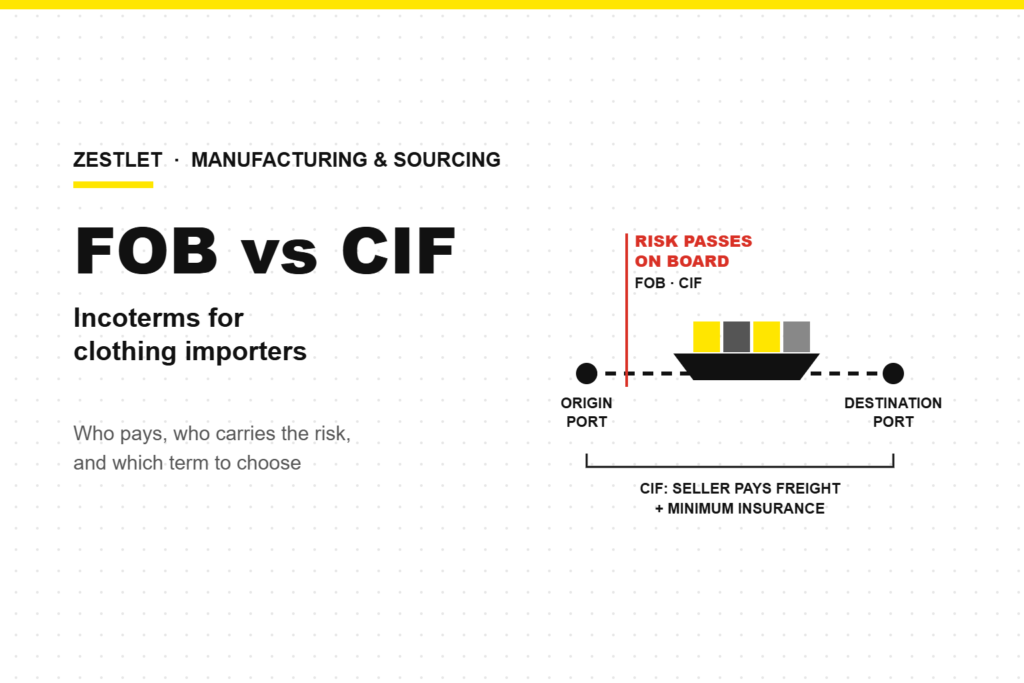
FOB and CIF are two of the most common shipping terms on garment quotations, and the difference between them decides who pays for the sea freight, who buys insurance and who carries the risk while the goods are at sea. Choosing the wrong term, or not naming one at all, is a frequent source of disputes and unexpected costs for clothing importers.
This guide explains FOB and CIF in plain language, compares them with the other Incoterms rules garment buyers meet, and shows how to choose the right one for an apparel order. It is general guidance, not legal advice; the exact obligations are set out in the ICC’s Incoterms rules.
What Incoterms are
Incoterms are standard trade terms published by the International Chamber of Commerce (ICC). Each three-letter rule defines where the seller delivers the goods, when risk passes to the buyer, and which party pays which costs. The current edition is Incoterms 2020; there is no “Incoterms 2026” edition, and the ICC’s next revision is still in development. Incoterms are not laws: they apply only when your contract names them, so always write the rule, the named place and the edition, for example “FOB Karachi, Incoterms 2020”.
Incoterms do not cover payment terms, the price, transfer of ownership or what happens if goods are defective. Those belong in your purchase order and manufacturing agreement.
FOB: Free On Board
Under FOB, the seller clears the goods for export and loads them on board the vessel nominated by the buyer at the named port of shipment. Risk passes to the buyer once the goods are on board. From that point, the buyer pays the main sea freight, insurance, import clearance, duties and delivery to the warehouse.
Why buyers choose FOB: the buyer controls the freight forwarder, shipping line and insurance, often at better rates if they ship regularly, and can see every freight cost directly.
CIF: Cost, Insurance and Freight
Under CIF, the seller also clears export and loads the goods, and additionally pays for the sea freight and a minimum level of cargo insurance to the named destination port. The important detail: risk still passes to the buyer when the goods are on board at the port of shipment, not at destination. If something happens at sea, the buyer claims under the insurance policy the seller arranged. Under Incoterms 2020 the default CIF cover is the minimum level (Institute Cargo Clauses C), unless the parties agree more.
Why buyers choose CIF: a single price that includes freight is simpler for small or first-time importers who do not yet have a forwarder.
FOB vs CIF at a glance
| FOB | CIF | |
|---|---|---|
| Export clearance | Seller | Seller |
| Main sea freight | Buyer | Seller |
| Cargo insurance | Buyer decides | Seller buys minimum cover |
| Risk passes | On board at port of shipment | On board at port of shipment |
| Import clearance and duties | Buyer | Buyer |
| Freight control | Buyer chooses carrier and forwarder | Seller chooses carrier |
| Transport mode | Sea and inland waterway only | Sea and inland waterway only |
Other Incoterms garment buyers meet
| Rule | In short | When it suits apparel orders |
|---|---|---|
| EXW – Ex Works | Goods made available at the factory; buyer handles almost everything, including export formalities | Experienced buyers with a local agent; risky for most because export clearance is not the seller’s job |
| FCA – Free Carrier | Seller delivers to the buyer’s carrier at a named place, export cleared | Container and air shipments; often a better fit than FOB when goods are handed over at a terminal |
| CFR – Cost and Freight | Like CIF without the insurance | Buyers with their own cargo insurance |
| CIP – Carriage and Insurance Paid | Seller pays carriage and a higher level of insurance (Institute Cargo Clauses A) to a named place; works for any transport mode | Air freight and containers where the buyer wants seller-arranged insurance |
| DAP – Delivered at Place | Seller delivers to a named destination, buyer handles import clearance and duties | Buyers who want delivery arranged but control their own customs |
| DDP – Delivered Duty Paid | Seller delivers to the destination and handles import clearance and duties | Small buyers wanting a landed price; the seller must be able to clear customs in your country |
FOB, CFR and CIF are intended for sea and inland waterway transport. For air freight, courier shipments and many containerised shipments, the “any mode” rules such as FCA, CPT, CIP, DAP and DDP usually fit better.
How to choose for a clothing order
- First order, no forwarder: CIF or DAP keeps things simple, but ask for the freight and insurance to be shown separately.
- Regular importer with a forwarder: FOB or FCA gives you control of freight cost and timing.
- Air freight or courier: use FCA, CPT, CIP or DAP rather than FOB or CIF.
- You want a fully landed price: DDP, but confirm the seller can legally act as importer in your country and that duties are calculated correctly.
- Comparing quotations: convert every quote to the same basis, ideally your landed cost, before comparing. See how much it costs to manufacture clothing.
Common mistakes
- No named place: “FOB” alone is incomplete; write “FOB Karachi” or “FOB Sialkot dry port” as agreed.
- Assuming CIF means the seller carries the risk at sea: it does not; risk passes on board at origin.
- Relying on minimum insurance: CIF’s default cover may not be enough for high-value goods; agree a higher level or buy your own.
- Using sea terms for air freight: choose an any-mode rule instead.
- Forgetting destination charges: port, handling and brokerage fees at destination are usually the buyer’s under FOB and CIF.

Frequently asked questions
What is the difference between FOB and CIF?
Under FOB the buyer pays the sea freight and insurance; under CIF the seller pays freight and minimum insurance to the destination port. Under both, risk passes to the buyer once the goods are on board at the port of shipment.
Is FOB or CIF cheaper?
A CIF price is higher because it includes freight and insurance, but the total cost may be similar or higher under FOB depending on the rates you can get. Compare landed costs, not the headline prices.
Which Incoterm should a small clothing brand use?
Many small brands start with CIF, DAP or DDP for simplicity, then move to FOB or FCA once they have a reliable freight forwarder and regular shipments.
Do Incoterms decide who owns the goods?
No. Incoterms deal with delivery, risk and costs. Ownership and payment are set by your sales contract and payment terms.
Which shipping terms does ZESTLET quote?
ZESTLET can quote on the Incoterms rule you need, based on your destination and shipping method. State your preferred rule and named place when requesting a quotation.
Sources and related guidance
Official source: ICC: Incoterms® 2020. Summary of the 2020 changes: Noerr, Incoterms 2020. Related ZESTLET guides: clothing samples and sample costs, clothing label requirements and choosing a clothing manufacturer.