ZESTLET · OEM / ODM · Private Label
Custom Camouflage Combat Uniforms: Patterns, Printing Methods and Licensing Explained
By ZESTLET Editorial Team · Updated October 27, 2026
Custom camouflage combat uniforms begin with an authorized pattern, a fabric specification and a coordinated jacket-and-trouser tech pack. ZESTLET in Sialkot develops commercial OEM and private-label uniform sets around approved fabric, color, sizing, decoration and samples. Buyers should agree print capability, artwork rights, testing, quantity and delivery schedule before production.
Which camouflage patterns suit your uniform brief?
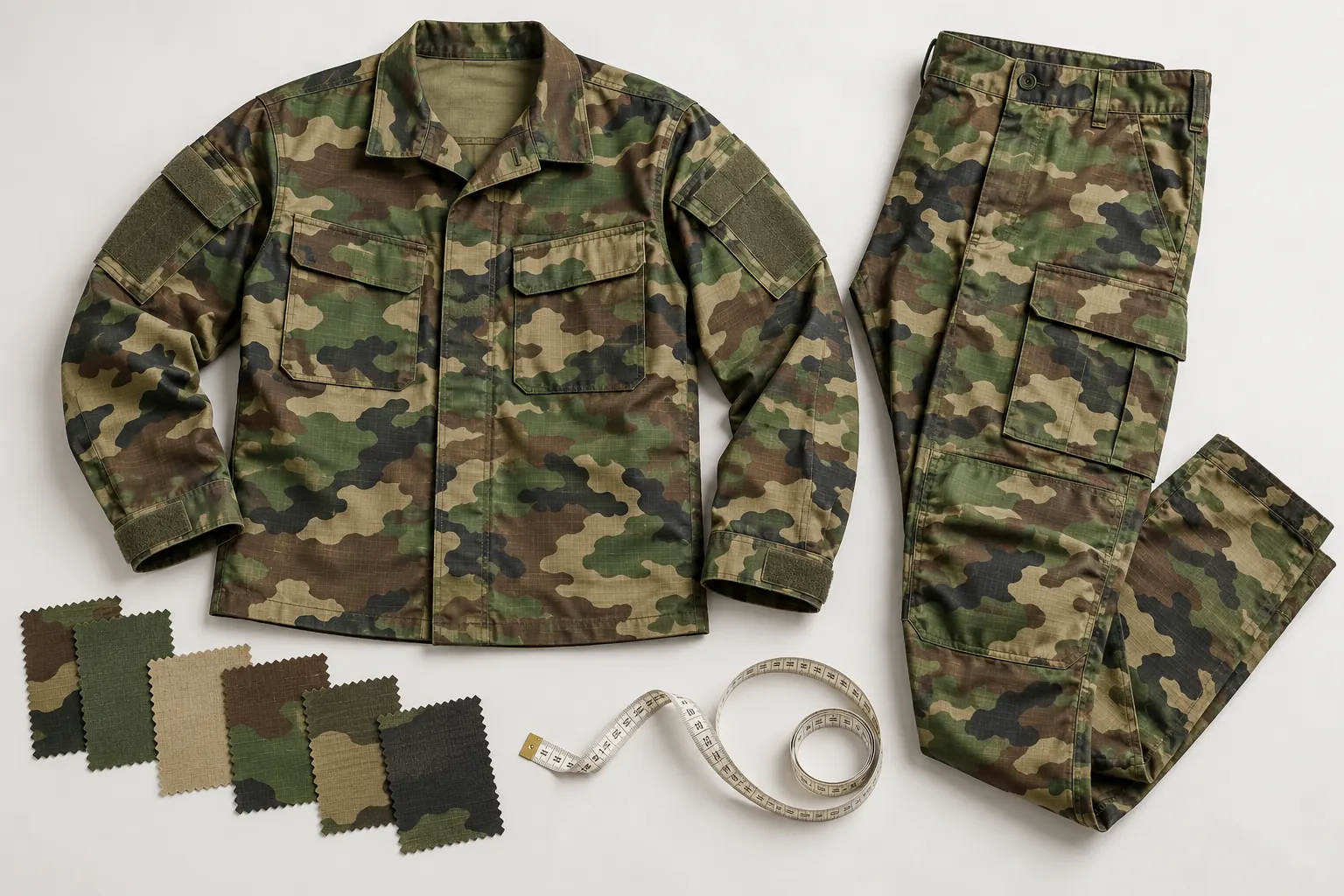
Choose a pattern by the intended environment, the customer’s visual brief and the rights to the artwork. Woodland, desert, urban, digital and multi-terrain are broad design descriptions, not guarantees of concealment. Compare printed fabric samples in relevant conditions, then confirm the pattern scale and shades on both the jacket and trousers.
- Woodland: greens, browns and dark shapes for a vegetation-inspired look.
- Desert: tan, sand and earth shades for a dry-environment aesthetic.
- Urban: grey, black and muted neutral palettes for an urban-inspired brief.
- Digital: pixel-like shapes; the name describes style, not performance.
- Multi-terrain: a mixed palette intended for varied visual settings; proprietary designs require permission.
- Original client artwork: a buyer-supplied repeat, colors and specifications with the necessary rights.
The appropriate design depends on real-world use and buyer evaluation. A picture on a screen is not evidence of concealment, official issue or protection. Start with a reference swatch and a clear list of environments, users and expected washing conditions.
Which fabric works for a camouflage uniform set?
Fabric selection affects the appearance, comfort and durability of a print. The ACU-style product offers poly-cotton ripstop, cotton ripstop and nylon-cotton development options, subject to sourcing and sample approval. Agree the actual mill article, composition, fabric weight, usable width, finish and wash tolerances before committing to a production run.
A 65/35 polyester-cotton option, 100% cotton option and 50/50 nylon-cotton option can be discussed. Their names do not guarantee a specific GSM, colorfastness or protective performance. The product’s actual mill grade and weight remain to be confirmed; request the supplier’s current specification rather than relying on an online estimate.
Compare the fabric choices in our ripstop, poly-cotton and NYCO fabric guide. For jacket and trouser construction choices, review the custom ACU-style combat uniform set.
How are camouflage fabrics printed?
Common industry approaches include screen printing and digital textile printing; solid-color dyeing produces a single shade rather than a camouflage pattern. The best route depends on artwork, fabric, quantity and supplier capability. Ask ZESTLET to confirm the method and production partner for your particular order before approving the quote.
| Method | Typical use | What to confirm |
|---|---|---|
| Screen / rotary textile printing | Repeat patterns and defined colors on fabric. | Screen preparation, minimum fabric quantity, repeat, setup costs and approved supplier. |
| Digital textile printing | Detailed or variable artwork, depending on material and equipment. | Ink and fabric compatibility, order size, wash performance and availability. |
| Solid-color dyeing | One uniform fabric shade; not a printed camouflage design. | Shade tolerance, dye-lot consistency, composition and finish. |
These are industry explanations, not a claim that every method is performed in-house. For artwork, specify the file format, repeat dimensions, required colors and the intended finished fabric. Ask for a strike-off or equivalent trial and approve it on the actual cloth; different fiber blends can change the final appearance.
How should buyers approve colors and print quality?
Define a physical color reference and agree the approval process before bulk production. A lab dip can help assess an individual shade, while a strike-off shows a trial of the printed pattern on fabric. Confirm the light conditions, tolerances and testing method with the supplier; actual availability depends on the order.
- Supply an authorized digital repeat, color references and the target fabric.
- Review a physical color sample or lab dip where appropriate; agree acceptable shade variation.
- Review a print strike-off or equivalent trial on the specified cloth, including repeat size and edge detail.
- Approve a complete garment sample and keep a signed reference for production.
- Specify wash and rubbing colorfastness, dimensional change and other tests for the order; request the applicable report and its tested sample.
Check the fabric under consistent lighting and after an agreed wash procedure. For a matched set, compare jacket and trousers as well as pocket flaps and reinforcement panels. If pieces come from different dye lots or rolls, record the decision and any acceptable variation before cutting.
Can you use a branded or government camouflage pattern?
Use original artwork, a genuinely available generic design, or a pattern for which the buyer has the necessary permission. Names, artwork and reproduction rights may be protected by trademark, copyright, licensing agreements or procurement rules. Ask the rights holder or qualified counsel about the specific design and destination before production.
Do not assume that a pattern found online is free to reproduce. Provide evidence of authorization where the design or insignia belongs to another party. An ACU-style cut is a garment design brief, not proof of government approval, official issue or permission to reproduce protected pattern artwork.
Why do repeat direction and pattern placement matter?
Camouflage repeat size affects how fabric is laid, cut and matched across seams, pockets and jacket-trouser sets. A placement plan helps keep the intended visual balance and can reduce surprises in material consumption. Agree whether exact seam matching is required, because tighter matching can increase fabric waste and cost.
Discuss directional motifs, left-right placement, pocket flap alignment and whether the sleeves or reinforcement panels use the same fabric. Review the marker and sample before cutting. Record approved roll lots and shade references so the factory can group coordinated components and keep sizes together through production.
Does camouflage fabric automatically have near-infrared performance?
No. A visible camouflage print alone does not establish near-infrared performance. If your order has an NIR requirement, provide the exact standard, wavelength range, tolerances and end use, then ask whether the specified fabric and finish can be sourced and supported by a suitable report for the tested material.
Do not treat a supplier’s general brochure or another fabric’s test as proof for your order. Confirm the laboratory, issue date, sample identification, test method and acceptance criteria. ZESTLET must verify availability and documentation for the specific brief before making any such claim.
How do you order and approve a custom uniform sample?
Start with a jacket and trouser tech pack, authorized pattern file, desired quantity, destination market and size breakdown. ZESTLET develops the set around agreed fabric, trims, measurements, branding and packing. Sampling is free and the buyer pays shipping; the exact MOQ and lead time are confirmed for the individual order.
- Send your design, artwork authorization, target use and technical requirements.
- Discuss fabric sourcing, print method, labels, color references, testing and quotation.
- Approve swatches, the print trial and jacket-and-trouser measurements.
- Review the sample for fit, reach, kneeling, pocket access and color consistency.
- Agree final quantities, the production schedule, inspection and packing in writing.
Ask for a separate size chart for each garment and specify whether the set can contain different jacket and trouser sizes. For customers who need matching cargo trousers, see the tactical cargo pants product page. Discuss the finished set and available documentation through the uniform quotation form.
Frequently asked questions
Can I supply my own camouflage design?
Yes. Send a production-ready repeat and the color references with your uniform tech pack. Confirm that you own the artwork or have permission to use it. ZESTLET can review the brief and discuss a suitable fabric, sample and printing arrangement subject to availability.
What fabric weight should I choose?
Choose the weight for your climate, durability and comfort requirements, then request the actual mill specification and a sample. The available product options include cotton, polyester-cotton and nylon-cotton ripstop. Their GSM is not fixed on the current product page and must be confirmed for the selected fabric.
Can the jacket and trousers use matching camouflage?
Yes, a coordinated set can be developed using an agreed fabric and color reference. Ask for the jacket, trousers, pockets and reinforcement panels to be checked together. Approve the print scale, dye lot and any seam-matching requirement on a physical sample before cutting.
Are camouflage uniforms automatically military-approved or NIR compliant?
No. A pattern or ACU-style cut does not establish official issue, military acceptance or NIR performance. Any special requirement needs the exact material specification, applicable approval and evidence covering the tested product. Discuss the requested standard and documentation before making a protective or procurement claim.
What are the sample cost, MOQ and lead time?
Sampling is free and the buyer pays shipping. Minimum order and production time depend on the approved design, material sourcing, decoration and quantities; confirm them with the team for your particular order. Send the tech pack, destination and approximate size breakdown for a meaningful quotation.
Ready to develop your camouflage uniform?
Share your authorized design, technical requirements and destination market with our Sialkot team. We can discuss fabric samples, jacket and trouser specifications, printing options and applicable documentation for your order.
Send your camouflage design and request a sample · Explore the tactical combat uniform set