
ZESTLET · OEM / ODM · Private Label
Tartan Trews Problems: Seat, Rise, Waistband and Tartan Matching (and How to Avoid Them)
Build Now, Pay Later · New brands welcome
Launch your brand from 20 pieces. Pay the balance after your stock arrives.
ZESTLET makes your tactical, hunting, uniform and Highland products under your own label. Your first sample and branding setup are free, and orders from $5,000 can pay 60% after delivery.
Budget under $5,000
Startup Launch
- Start from 20 pieces per product
- Your first sample is free
- Labels, screens and digitising are free
- Bulk starts only after you approve the sample
Orders from $5,000
Build Now, Pay Later
- Pay 40% to start production
- Pay the other 60% monthly after delivery
- No interest and no application fee
- Your limit grows with every on-time payment
Your full journey with ZESTLET, step by step
From your first idea to stock in your warehouse. Every step is visible in your free brand dashboard.
- 1Create your free brand accountSign up in about one minute. We email you a 6-digit code to confirm your account.
- 2Check your credit in 30 secondsAnswer 3 short questions in your dashboard and see your pre-qualified credit limit straight away.
- 3Start your projectUpload your design or tech pack, choose the product and quantity. You can start from 20 pieces per product.
- 4Get your quotation within 24 hoursPrice per piece, lead time and payment terms in writing, from real people in Sialkot.
- 5Free sample with your brandingWe make your sample with your logo in 7–10 working days. You only pay the sample shipping.
- 6Approve and pay 40%Bulk production starts only after you approve the sample and pay the 40% deposit.
- 7Production and quality checksCutting, stitching, inspection and packing, with progress updates in your dashboard.
- 8Delivery, then pay 60% monthlyDoor-to-door shipping. Credit orders pay the balance after delivery over 90 to 365 days, with no interest.
What you need to apply
- Your brand name and contact details
- Your product idea, design or tech pack
- An order value from $5,000 for Build Now, Pay Later
- For higher limits: sales history or business registration
Your credit limit grows with you
First credit order
After 2 orders paid on time
After 4 cycles and a review
- Deposit
- 40%
- Balance after delivery
- 60%, monthly
- Repayment
- 90 to 365 days
- Interest and fees
- None
Can I start a clothing brand with a small budget?
Yes. You can start from 20 pieces per product, and your first sample and branding setup are free, so your budget goes into product.
Who can use Build Now, Pay Later?
Brands with orders from $5,000, including new brands with no sales history, after a short review. You pay 40% upfront and 60% in monthly instalments after delivery.
Is the sample free?
Yes, the first sample is made free with your branding. Sample shipping is paid by the buyer.
Credit is subject to approval. Amounts shown in your local currency are approximate.
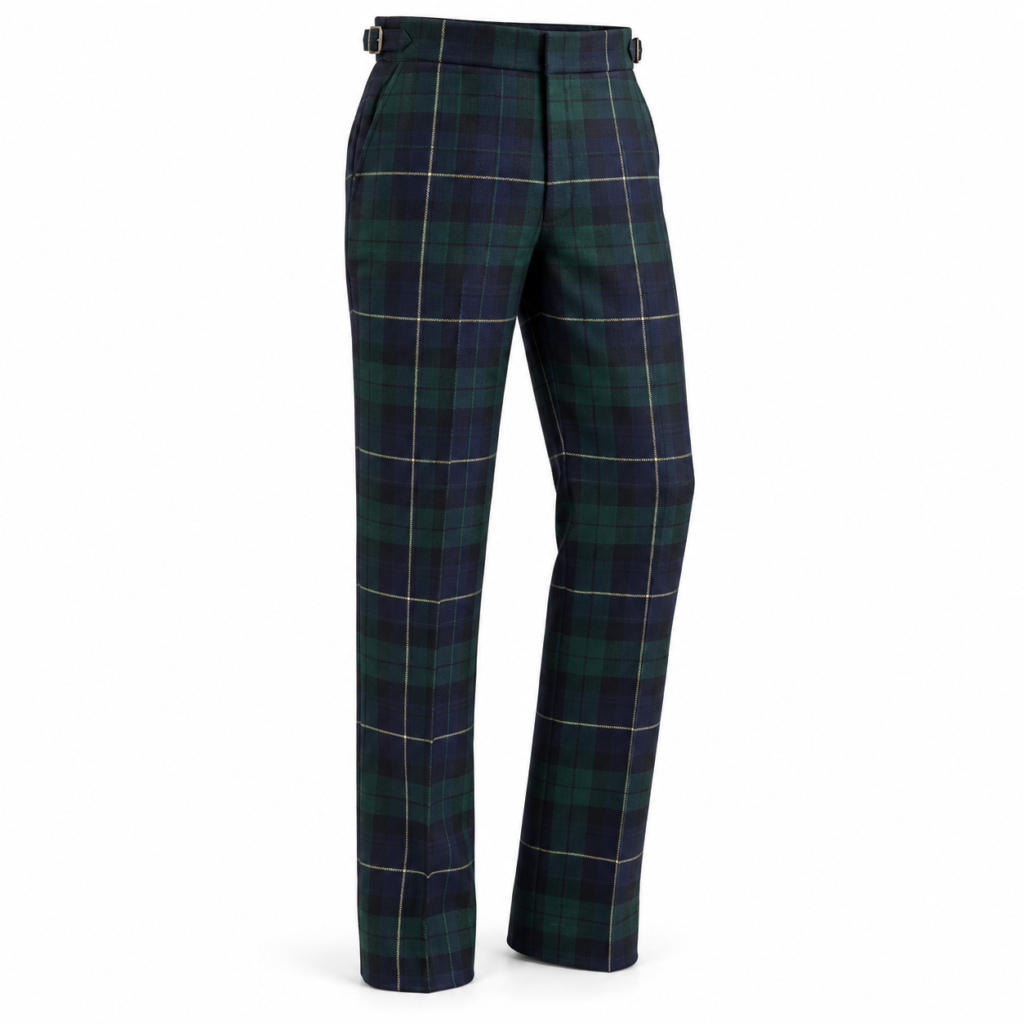
Tartan trews look simple on a product page: tailored trousers in a check cloth. In practice they are one of the easiest Highland garments to get wrong. The rise has to suit a short jacket, the waistband has to suit the way they are held up, and the tartan has to line up where the eye expects it to. When any of these is left to chance, the result is a pair of trousers that measures correctly on paper but looks and feels wrong when it is worn.
This guide collects the problems buyers most often meet with tartan trews, why they happen, and what to put in the brief so they do not happen on your order.
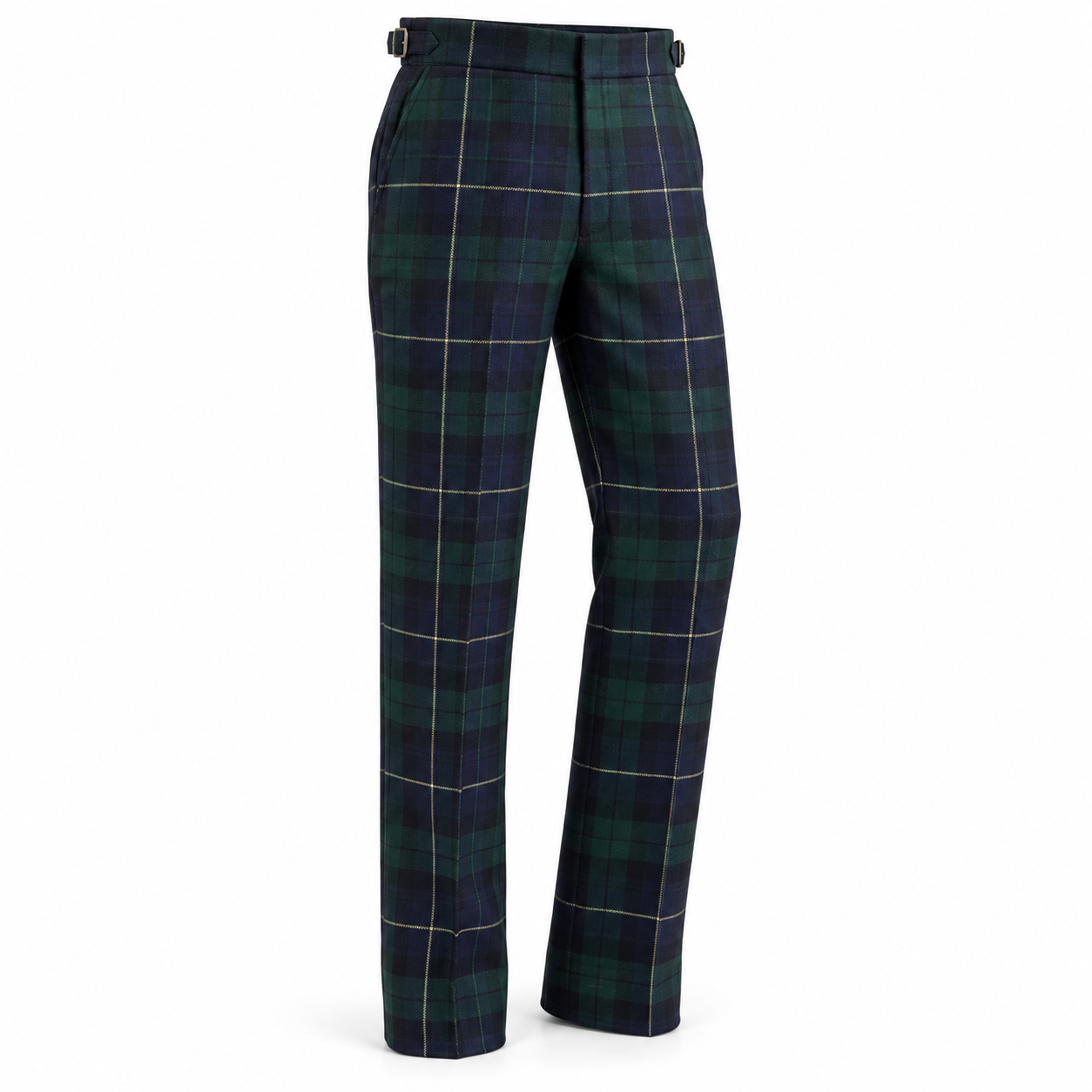
1. The seat and rise feel tight when the wearer sits
The most common complaint is a pair that fits standing up but pulls across the seat or cuts in at the front when the wearer sits down at a dinner or wedding. This is almost never a waist problem. It comes from a rise or seat measurement that was never specified, so the pattern used a default.
How to avoid it: give front and back rise and the seat measurement as well as waist and inseam, state whether the trews are worn at a high or a conventional waist level, and try the sample seated. A longer inseam will not correct a short rise.
2. The waistband does not suit the support method
Trews can be held up with belt loops, side adjusters or brace buttons, and the waistband can be straight or have a fishtail back. Problems start when these are chosen separately: brace buttons on a low waistband, belt loops that clash with a fishtail back, or side adjusters that sit under a lining seam.
How to avoid it: decide the support method and the waistband shape together, before sampling, and check the sample with the braces or belt that will actually be used.
3. The tartan does not match at the seams
A check cloth makes every misalignment visible. Typical faults are horizontal lines that step at the side seam, a dominant line that falls in an awkward place across the seat, or two legs that do not mirror each other at the front. Larger setts make this more noticeable.
How to avoid it: state the sett size and orientation, and say which matching points matter most to you (for example side seams, centre front, or the line across the seat). Approve placement on a physical sample, not on a flat rendering.
4. The cloth is not what was expected
Tartan names alone do not describe a fabric. Two cloths with the same pattern can differ in fibre, weight, colourway and handle. Buyers sometimes receive trews that are correct in pattern but wrong in shade compared with the kilt, jacket or sash they must be worn with.
How to avoid it: approve a woven tartan with a declared fibre composition, keep a physical swatch, and compare it in daylight with the other pieces of the outfit. For a coordinated outfit, see our Prince Charlie jacket buyer’s guide.
5. Lining that rubs or bunches
Lining coverage is a real choice: full, part or none. Too much lining in a warm cloth can feel heavy; no lining in a coarse cloth can feel rough against the skin. Lining that is cut without enough ease can twist the leg.
How to avoid it: specify coverage and the comfort you want, and check the sample for drag at the knee and seat.
6. Hem length that cannot be corrected
For hire stock and wedding groups, a finished length that is slightly wrong is expensive if there is no turn-up allowance. For made-to-measure orders, an alteration allowance is often unnecessary.
How to avoid it: tell the factory whether you want a finished length or an agreed alteration allowance, per size or per wearer.
Quick problem table
| Problem | Usual cause | What to specify or check |
|---|---|---|
| Tight when seated | Rise and seat not given | Front/back rise, seat, seated try-on |
| Waistband rolls or gapes | Support chosen separately from waistband | Waistband shape plus braces, loops or adjusters |
| Checks step at the seams | No matching priorities | Sett size, orientation, key matching points |
| Shade differs from the kilt or jacket | Approved from a photo | Physical swatch, daylight comparison |
| Lining twists or rubs | Coverage and ease not defined | Lining coverage, sample checked moving |
| Wrong length on group orders | No hem decision | Finished length or alteration allowance |
Size labels from different countries are not a substitute for garment measurements, which is why the measurement brief matters so much. For measurements, fabrics and features, read our tartan trews buyer’s guide, and see how tartan trews are made step by step.
Develop your tartan trews with ZESTLET
ZESTLET in Sialkot, Pakistan develops tartan trews for Highland outfitters, retailers, wedding hire businesses and band suppliers, to your pattern, cloth and branding.
- Small batches with a project-specific MOQ
- Sample first, approved before bulk
- Private label with your labels and packing
See the Tartan Trews or request a quote and send your brief.
FAQ
Why do my trews fit standing but feel tight sitting?
Usually the rise or seat measurement was not specified. Give front and back rise and seat, and check the sample while seated.
Should trews have brace buttons or belt loops?
It depends on the waistband and the outfit. Choose the support method together with the waistband shape before sampling so they do not conflict.
How can I make sure the tartan matches at the seams?
State the sett size, orientation and the matching points that matter most, then approve placement on a physical sample.
Can the trews match my kilt or jacket cloth?
Send the reference cloth or a swatch. Shade is approved by comparing physical samples in daylight, not from photos.
What should I check on the sample?
Seated fit, waistband with the actual braces or belt, tartan alignment at seams, lining comfort and hem length.