
ZESTLET · OEM / ODM · Private Label
Montrose Jacket Problems: Closed-Front Fit, Collar, Button Rows and Braid (and How to Avoid Them)
Build Now, Pay Later · New brands welcome
Launch your brand from 20 pieces. Pay the balance after your stock arrives.
ZESTLET makes your tactical, hunting, uniform and Highland products under your own label. Your first sample and branding setup are free, and orders from $5,000 can pay 60% after delivery.
Budget under $5,000
Startup Launch
- Start from 20 pieces per product
- Your first sample is free
- Labels, screens and digitising are free
- Bulk starts only after you approve the sample
Orders from $5,000
Build Now, Pay Later
- Pay 40% to start production
- Pay the other 60% monthly after delivery
- No interest and no application fee
- Your limit grows with every on-time payment
Your full journey with ZESTLET, step by step
From your first idea to stock in your warehouse. Every step is visible in your free brand dashboard.
- 1Create your free brand accountSign up in about one minute. We email you a 6-digit code to confirm your account.
- 2Check your credit in 30 secondsAnswer 3 short questions in your dashboard and see your pre-qualified credit limit straight away.
- 3Start your projectUpload your design or tech pack, choose the product and quantity. You can start from 20 pieces per product.
- 4Get your quotation within 24 hoursPrice per piece, lead time and payment terms in writing, from real people in Sialkot.
- 5Free sample with your brandingWe make your sample with your logo in 7–10 working days. You only pay the sample shipping.
- 6Approve and pay 40%Bulk production starts only after you approve the sample and pay the 40% deposit.
- 7Production and quality checksCutting, stitching, inspection and packing, with progress updates in your dashboard.
- 8Delivery, then pay 60% monthlyDoor-to-door shipping. Credit orders pay the balance after delivery over 90 to 365 days, with no interest.
What you need to apply
- Your brand name and contact details
- Your product idea, design or tech pack
- An order value from $5,000 for Build Now, Pay Later
- For higher limits: sales history or business registration
Your credit limit grows with you
First credit order
After 2 orders paid on time
After 4 cycles and a review
- Deposit
- 40%
- Balance after delivery
- 60%, monthly
- Repayment
- 90 to 365 days
- Interest and fees
- None
Can I start a clothing brand with a small budget?
Yes. You can start from 20 pieces per product, and your first sample and branding setup are free, so your budget goes into product.
Who can use Build Now, Pay Later?
Brands with orders from $5,000, including new brands with no sales history, after a short review. You pay 40% upfront and 60% in monthly instalments after delivery.
Is the sample free?
Yes, the first sample is made free with your branding. Sample shipping is paid by the buyer.
Credit is subject to approval. Amounts shown in your local currency are approximate.
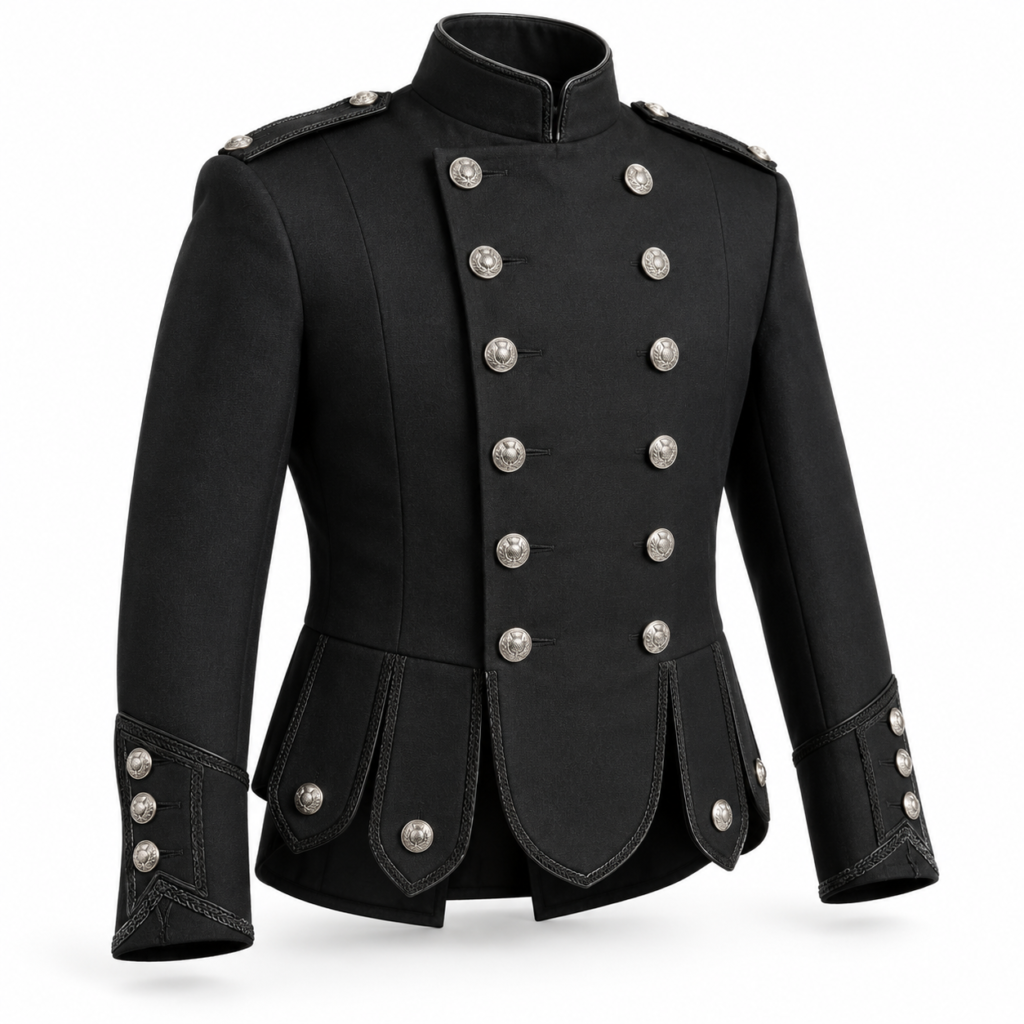
The Montrose jacket is a Highland doublet with a high standing collar and a closed, double-breasted front, finished with decorative skirt panels, cuffs and button rows. Because it is worn fastened, it shows every fitting error that an open evening coatee can hide. A Prince Charlie can be a little loose at the waist and nobody notices; a Montrose that is loose at the waist looks borrowed.
For Highland outfitters, retailers and pipe band suppliers, these are the problems that come up most often when developing Montrose doublets, and how to prevent them before bulk production.
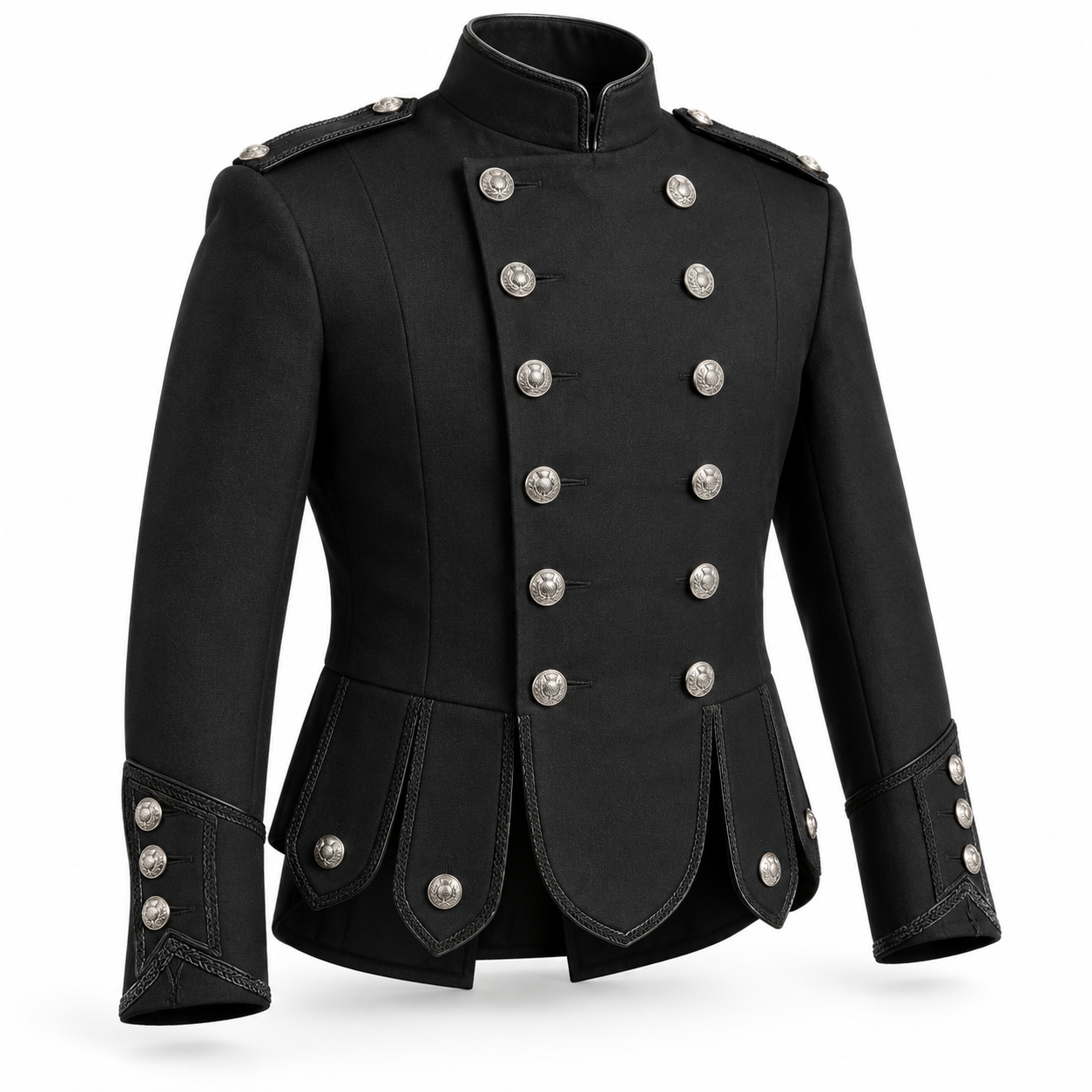
1. Measurements copied from an open coatee
The most common mistake is starting from a Prince Charlie or Argyll pattern and simply closing the front. An open jacket never has to meet across the chest and waist, so its ease is planned for a waistcoat showing underneath. A closed double-breasted front needs its own chest and waist ease, and the overlap adds layers of cloth, interfacing and buttons at the centre.
How to avoid it: brief the Montrose as its own garment. Ask for a pattern drafted for a fastened front, and approve the chest and waist on a sample that is buttoned, with the wearer standing, sitting and raising the arms.
2. A standing collar that chokes or collapses
The high collar is the signature of the jacket. If it is cut too close it rubs the neck and makes playing or marching uncomfortable; if the interfacing is too soft it folds over after a few wears and the whole silhouette loses its line.
How to avoid it: specify collar height and neck measurement separately, agree the support material, and check neck movement clearance on the sample: turning the head, looking down and, for band members, the playing position.
3. Button rows that drift
Two rows of buttons on a closed front are read as a pattern. A few millimetres of difference in spacing between the left and right rows, or rows that are not parallel to the centre front, stand out immediately, especially in photographs and on a band in line.
How to avoid it: put button spacing, row distance from centre front and button size on the specification drawing with an agreed tolerance. Approve the actual buttons, not a substitute, because shank height changes how the front sits.
4. Skirt panels and cuffs that do not sit flat
The decorative skirt panels below the waist and the braided cuffs are where the Montrose gets its ceremonial look. Common faults are skirt panels that flare or curl at the edges, braid that puckers on curves and cuff details that differ between left and right sleeves.
How to avoid it: define skirt depth, shape and edge treatment, braid width and shade, and the cuff design in the brief. Ask to see the braid application on a curved section during sampling, not only on a straight test piece.
5. Band orders that do not match
A single Montrose for a customer is one thing; twenty for a pipe band is another. Trim shades vary between lots, buttons get substituted, and reorders a year later do not match the first batch.
How to avoid it: record the approved cloth, braid, button and lining references, and agree a plan for spare components. Note that reproducing the look of a band’s dress does not imply any official or regimental approval; the band’s own authorised reference should guide trim and button choices.
6. Approving the jacket from a rendering
A digital visualization is useful for agreeing the idea, but it cannot show how barathea-style cloth or velvet behaves at the overlap, or how the collar feels on a neck.
How to avoid it: approve a physical sample in the real cloth, lining and trim. A substitute fabric can help with an early shape check, but stiffness and weight change the finished fit.
Problem and prevention checklist
| Problem | Where it starts | What to check on the sample |
|---|---|---|
| Tight or loose closed front | Pattern borrowed from an open coatee | Buttoned chest and waist, seated and arms raised |
| Uncomfortable or collapsing collar | Collar height and support not specified | Head turning, looking down, playing position |
| Uneven button rows | No spacing tolerance on the drawing | Measure both rows against centre front |
| Curling skirt panels, puckered braid | Edge treatment and braid not defined | Braid on curves, panels lying flat |
| Band reorders that do not match | Component references not recorded | Approved trim, button and cloth references on file |
| Fit only right in the rendering | Approval without a physical sample | Sample in the actual cloth and trim |
For cloth and measurement choices, read our Montrose jacket buyer’s guide, and see how a Montrose doublet is made. If you are comparing styles, the Prince Charlie jacket guide and the Sheriffmuir jacket guide cover the open-front alternatives.
Develop your Montrose doublets with ZESTLET
ZESTLET in Sialkot, Pakistan develops Montrose jackets for Highland outfitters, retailers and pipe band suppliers, in barathea-style cloth, velvet or a suitable alternative suiting.
- Small batches with a project-specific MOQ
- Sample first, approved before bulk
- Private label with your labels and packing
See the Montrose Jacket or request a quote and send your brief.
Frequently asked questions
Why does a Montrose jacket need a different pattern from a Prince Charlie?
The Montrose closes across the front under a standing collar, while the Prince Charlie is open with lapels. A closed front needs its own chest and waist ease and a planned overlap, so reusing an open coatee pattern often gives a poor fit.
What is the most common fitting fault?
Chest and waist ease that only works when the jacket is unbuttoned. Always approve the sample fastened, with the wearer sitting and raising the arms.
How can I keep a band order consistent?
Record the approved cloth, braid, button and lining references, keep a sealed sample, and agree spare components for future replacements.
Can the collar be made lower for comfort?
Collar height and neck clearance can be set in the brief. Check the result on a sample, because the collar defines the look of the jacket.
Can I approve a Montrose from a digital design?
Use the design to agree the idea, then approve a physical sample in the actual cloth, lining and trim before bulk production.