
ZESTLET · OEM / ODM · Private Label
Leather-Palm Work Gloves: 7 Problems Buyers Run Into and How to Avoid Them
Build Now, Pay Later · New brands welcome
Launch your brand from 20 pieces. Pay the balance after your stock arrives.
ZESTLET makes your tactical, hunting, uniform and Highland products under your own label. Your first sample and branding setup are free, and orders from $5,000 can pay 60% after delivery.
Budget under $5,000
Startup Launch
- Start from 20 pieces per product
- Your first sample is free
- Labels, screens and digitising are free
- Bulk starts only after you approve the sample
Orders from $5,000
Build Now, Pay Later
- Pay 40% to start production
- Pay the other 60% monthly after delivery
- No interest and no application fee
- Your limit grows with every on-time payment
Your full journey with ZESTLET, step by step
From your first idea to stock in your warehouse. Every step is visible in your free brand dashboard.
- 1Create your free brand accountSign up in about one minute. We email you a 6-digit code to confirm your account.
- 2Check your credit in 30 secondsAnswer 3 short questions in your dashboard and see your pre-qualified credit limit straight away.
- 3Start your projectUpload your design or tech pack, choose the product and quantity. You can start from 20 pieces per product.
- 4Get your quotation within 24 hoursPrice per piece, lead time and payment terms in writing, from real people in Sialkot.
- 5Free sample with your brandingWe make your sample with your logo in 7–10 working days. You only pay the sample shipping.
- 6Approve and pay 40%Bulk production starts only after you approve the sample and pay the 40% deposit.
- 7Production and quality checksCutting, stitching, inspection and packing, with progress updates in your dashboard.
- 8Delivery, then pay 60% monthlyDoor-to-door shipping. Credit orders pay the balance after delivery over 90 to 365 days, with no interest.
What you need to apply
- Your brand name and contact details
- Your product idea, design or tech pack
- An order value from $5,000 for Build Now, Pay Later
- For higher limits: sales history or business registration
Your credit limit grows with you
First credit order
After 2 orders paid on time
After 4 cycles and a review
- Deposit
- 40%
- Balance after delivery
- 60%, monthly
- Repayment
- 90 to 365 days
- Interest and fees
- None
Can I start a clothing brand with a small budget?
Yes. You can start from 20 pieces per product, and your first sample and branding setup are free, so your budget goes into product.
Who can use Build Now, Pay Later?
Brands with orders from $5,000, including new brands with no sales history, after a short review. You pay 40% upfront and 60% in monthly instalments after delivery.
Is the sample free?
Yes, the first sample is made free with your branding. Sample shipping is paid by the buyer.
Credit is subject to approval. Amounts shown in your local currency are approximate.
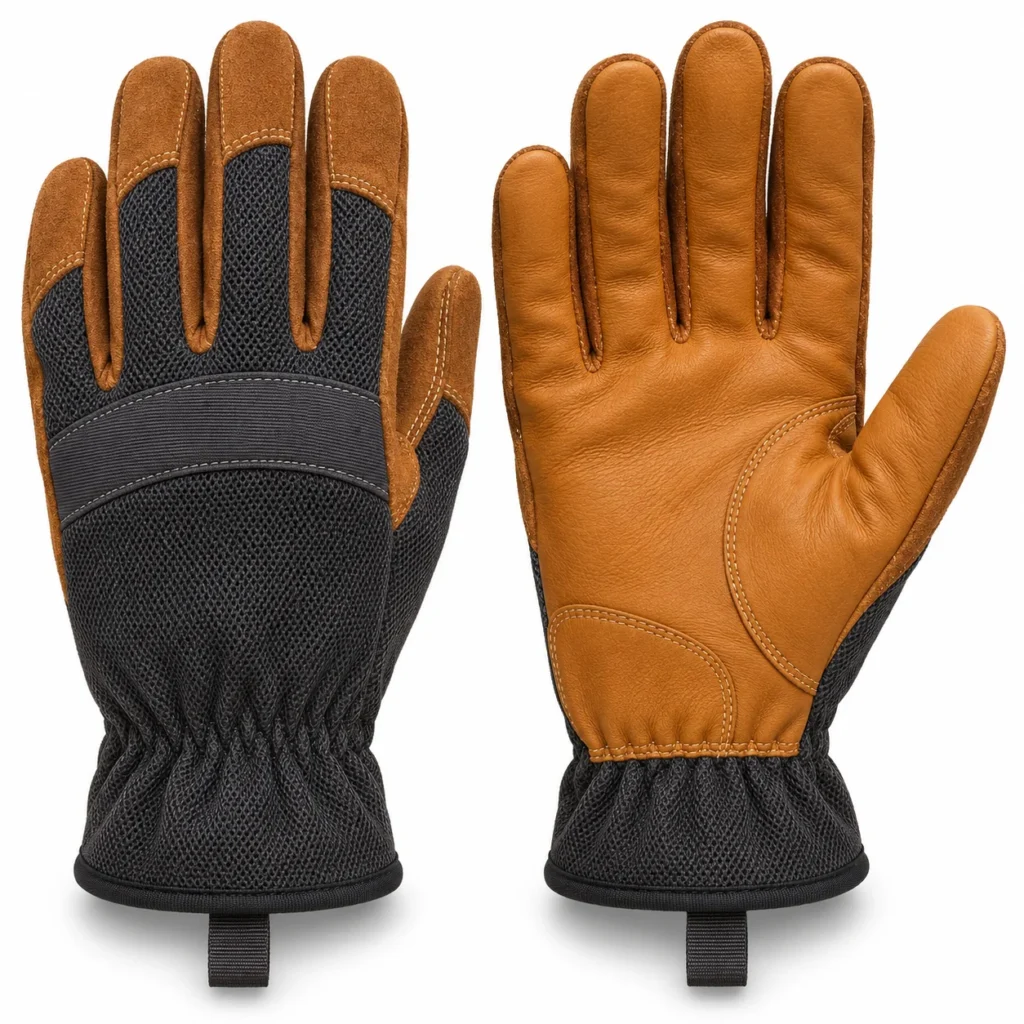
Slip-on leather-palm work gloves look simple: a leather palm, a textile back, an elastic cuff and a pull tab. That simplicity is exactly why problems slip through. There is no strap to hide a poor wrist fit, no coating to hide uneven leather, and users judge the glove within seconds of putting it on. This article covers the problems brand owners, shops and distributors most often meet with this style, and how to catch each one on the sample instead of in returns.

1. The leather turns stiff after use
Leather that feels soft on the first try can feel hard after the glove gets wet and dries, or after days of sweat. The cause is usually the leather itself: species, tannage, finish and thickness all change how it behaves. A thick, heavily finished palm may resist wear well but needs more effort to close the hand.
How to avoid it: compare swatches of more than one leather before sampling. Wear the sample through a real task, let it dry naturally and check it again. Then agree species, grade, finish and thickness in writing, so production uses the leather you approved and not a “similar” one.
2. The slip-on cuff is too tight, too loose or loses its grip
On this style the elastic cuff replaces an adjustable strap, so it does all the work. If the wrist opening is too small, the glove is hard to pull on and the bound edge is strained. If it is too loose, dirt gets in and the glove moves on the hand. Weak elastic can also lose its recovery after many donnings.
How to avoid it: put the wrist opening for every size on the size chart, not only hand dimensions. During sample review, pull the glove on and off many times and compare how the cuff recovers. If your users need a tight, adjustable closure, a strap model may suit them better than a slip-on.
3. Palm bunching and poor grip feel
Too much leather across the palm folds when the hand closes around a handle. Those folds create pressure points and reduce feel. This is a pattern problem, not a material problem, and a softer leather will not fully fix it.
How to avoid it: check the palm with a closed grip on the kind of handle or tool your customers actually use. Remove excess material in the pattern before the full size range is graded.
4. Thumb saddle wear and rubbing seams
The area between thumb and index finger takes heavy wear in most gripping tasks. Without reinforcement, or with a seam sitting exactly where the hand flexes, this is often where a glove fails first or starts to rub.
How to avoid it: confirm the thumb saddle reinforcement covers the real wear zone, and look at where seams sit while gripping. Internal finger seams should not press into the skin.
5. Finger lengths that do not match your users
Fingers that are too long leave empty tips that catch and reduce dexterity. Fingers that are too short pull the leather tight and stress the seams. A size label alone does not tell you which problem you have.
How to avoid it: work from hand measurements and finger lengths for each size, and fit samples on real hands at both ends of your range, not only the middle size.
6. Mismatched pairs
Leather is a natural material, so colour and texture vary between hides and even within one hide. If cutting and pairing are not controlled, a customer can open a pack with a left and right glove in different shades, or with the pull tab and overlays in different positions.
How to avoid it: make pair matching part of the written inspection criteria: shade, size and component placement checked on every pair before packing.
7. Claims the glove cannot back up
A leather palm looks protective, which tempts sellers to add words like “cut resistant”, “certified” or “machine washable” to a listing. None of these can be assumed. Without evidence for the finished glove, such claims lead to complaints, returns and legal risk.
How to avoid it: state only what is proven for the final complete glove. Care instructions must be approved for the actual leather, dyes and textile. If you need a protection rating, plan the required testing on the approved construction before you market it.
Sample review checklist
| Check | What to look for |
|---|---|
| Leather | Species, grade, finish and thickness match the approved swatch |
| Wet and dry | Feel after a real task and natural drying |
| Cuff | Donning effort, retention and recovery after repeated use |
| Palm | No large folds under a closed grip |
| Thumb saddle | Reinforcement covers the wear zone; seams do not rub |
| Fingers | Correct tip allowance in the smallest and largest size |
| Pull tab | Firmly anchored in the seam, agreed size and position |
| Pairs | Matched shade, size and placement |
| Labels and claims | Only approved information, no unproven protection or care claims |
If you also sell mesh-back mechanics gloves, several fit issues overlap; see our article on breathable mechanics glove problems. To choose leather, back fabric and sizes for this style, read Leather Palm Work Gloves Buyer’s Guide: Leather Types, Back Fabrics, Cuffs and Sizes. To follow each production step and what to check, see How Leather Palm Work Gloves Are Made: From Leather Selection to Matched Pairs.
Develop your leather-palm work gloves with ZESTLET
ZESTLET is a manufacturer in Sialkot, Pakistan, developing private-label work gloves for brands, shops and distributors.
- Small batches welcome
- Sample first, production after your approval
- Private label: your logo, labels and packaging
See the Slip-On Leather-Palm Work Gloves or request a quote.
FAQ
Why do leather-palm gloves get stiff after getting wet?
Water and drying affect leathers differently depending on species, tannage, finish and thickness. Test the sample in real use, let it dry naturally, and follow care instructions approved for the actual materials.
Is a slip-on elastic cuff as secure as a strap?
A slip-on cuff holds by elastic tension only and cannot be adjusted. It works well when the wrist opening is set correctly for each size. If users need an adjustable closure, choose a strap style.
Can I choose cowhide or goatskin for the palm?
Yes, discuss species, grade, finish and thickness during sourcing. Availability, cost and suitability are confirmed with material swatches and the sample.
Are these gloves machine washable?
No washability claim is made. Care instructions must be approved for the actual leather, dyes, textile and finished glove.
Does the leather palm give a certified protection level?
No rating is stated for this development model. Any PPE claim needs appropriate evidence for the final complete glove.