ZESTLET · OEM / ODM · Private Label
How a Sheriffmuir Doublet Is Made: From Collar Pattern to Final Inspection
Build Now, Pay Later · New brands welcome
Launch your brand from 20 pieces. Pay the balance after your stock arrives.
ZESTLET makes your tactical, hunting, uniform and Highland products under your own label. Your first sample and branding setup are free, and orders from $5,000 can pay 60% after delivery.
Budget under $5,000
Startup Launch
- Start from 20 pieces per product
- Your first sample is free
- Labels, screens and digitising are free
- Bulk starts only after you approve the sample
Orders from $5,000
Build Now, Pay Later
- Pay 40% to start production
- Pay the other 60% monthly after delivery
- No interest and no application fee
- Your limit grows with every on-time payment
Your full journey with ZESTLET, step by step
From your first idea to stock in your warehouse. Every step is visible in your free brand dashboard.
- 1Create your free brand accountSign up in about one minute. We email you a 6-digit code to confirm your account.
- 2Check your credit in 30 secondsAnswer 3 short questions in your dashboard and see your pre-qualified credit limit straight away.
- 3Start your projectUpload your design or tech pack, choose the product and quantity. You can start from 20 pieces per product.
- 4Get your quotation within 24 hoursPrice per piece, lead time and payment terms in writing, from real people in Sialkot.
- 5Free sample with your brandingWe make your sample with your logo in 7–10 working days. You only pay the sample shipping.
- 6Approve and pay 40%Bulk production starts only after you approve the sample and pay the 40% deposit.
- 7Production and quality checksCutting, stitching, inspection and packing, with progress updates in your dashboard.
- 8Delivery, then pay 60% monthlyDoor-to-door shipping. Credit orders pay the balance after delivery over 90 to 365 days, with no interest.
What you need to apply
- Your brand name and contact details
- Your product idea, design or tech pack
- An order value from $5,000 for Build Now, Pay Later
- For higher limits: sales history or business registration
Your credit limit grows with you
First credit order
After 2 orders paid on time
After 4 cycles and a review
- Deposit
- 40%
- Balance after delivery
- 60%, monthly
- Repayment
- 90 to 365 days
- Interest and fees
- None
Can I start a clothing brand with a small budget?
Yes. You can start from 20 pieces per product, and your first sample and branding setup are free, so your budget goes into product.
Who can use Build Now, Pay Later?
Brands with orders from $5,000, including new brands with no sales history, after a short review. You pay 40% upfront and 60% in monthly instalments after delivery.
Is the sample free?
Yes, the first sample is made free with your branding. Sample shipping is paid by the buyer.
Credit is subject to approval. Amounts shown in your local currency are approximate.
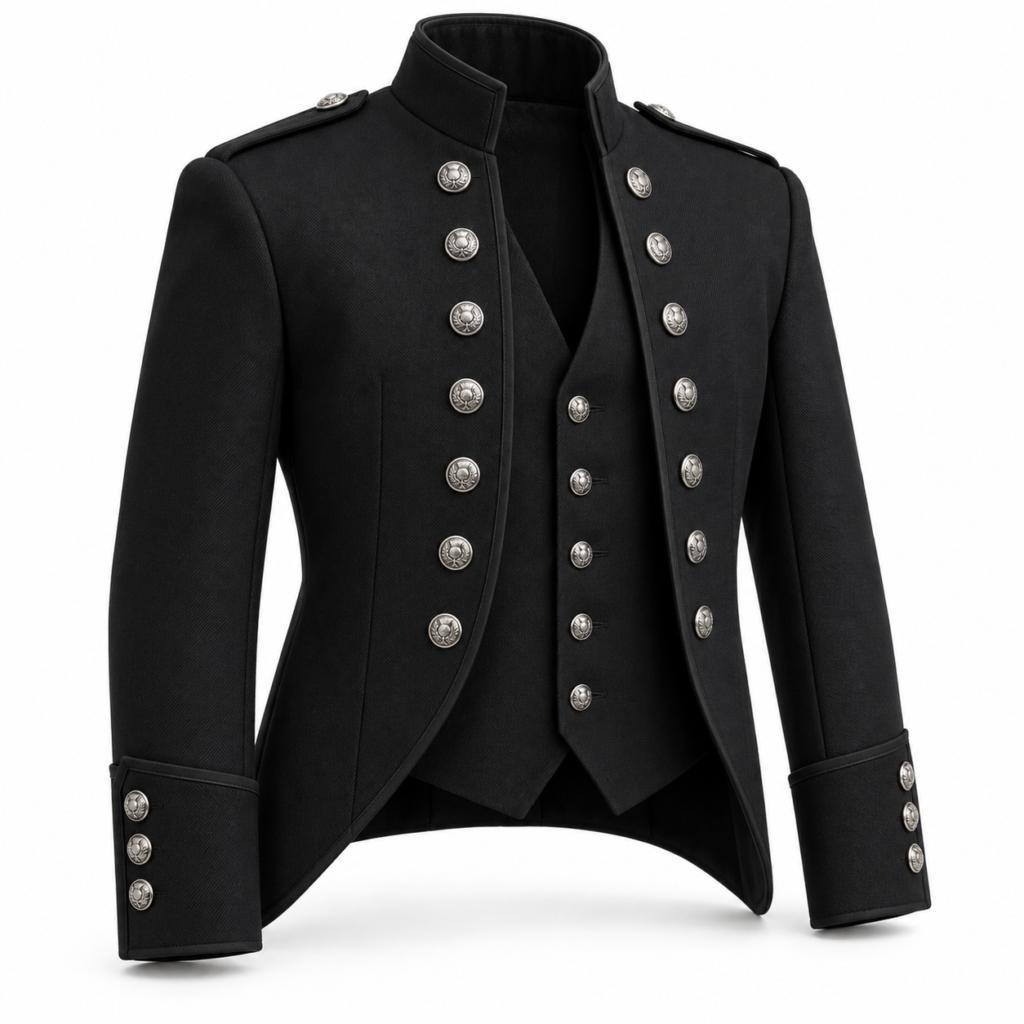
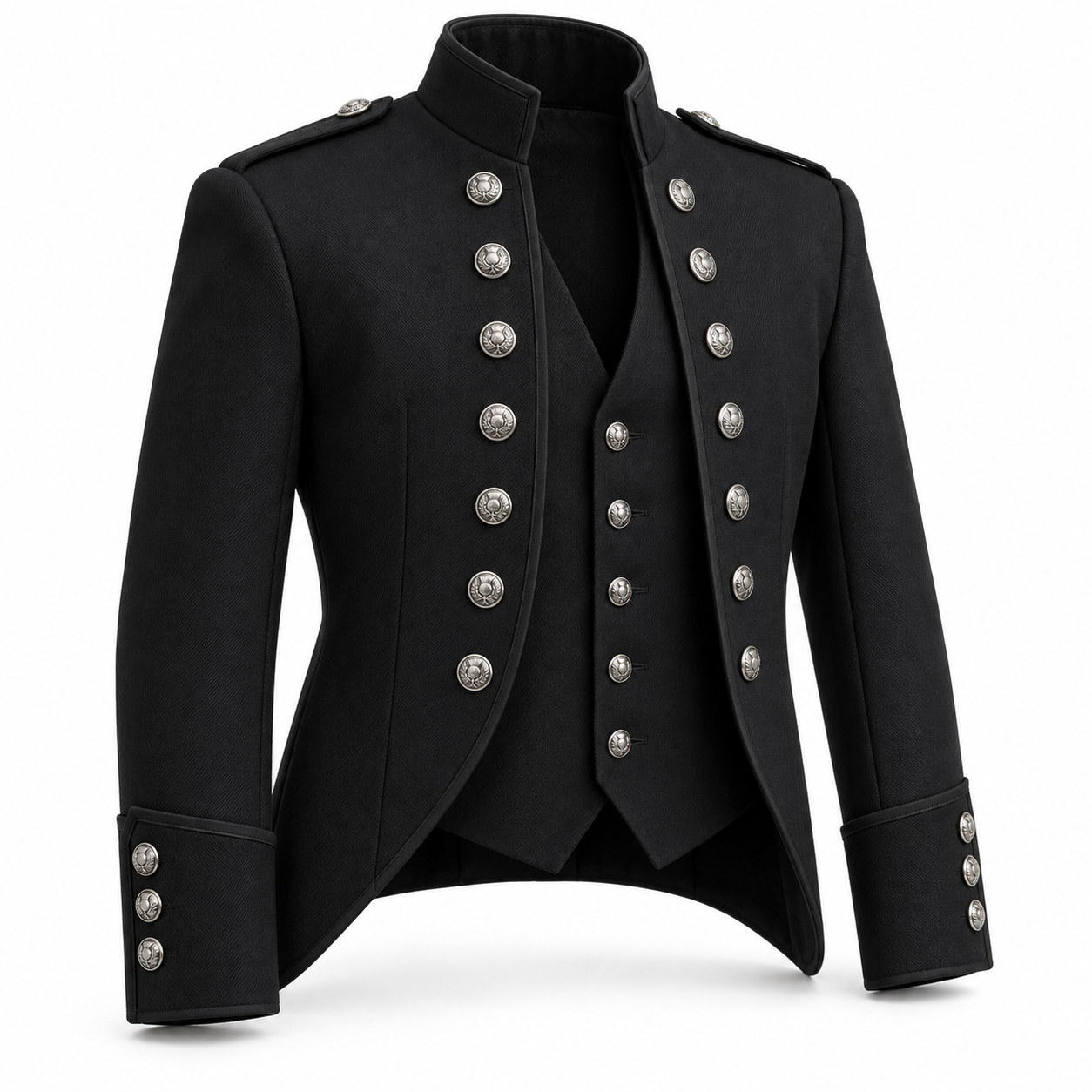
A Sheriffmuir doublet combines a structured body, a standing collar, a curved cut-away front, skirt panels and rows of decorative buttons. Each of these is a separate development point, and together they make the Sheriffmuir one of the more demanding Highland jackets to produce consistently. Here is how a Sheriffmuir jacket is made, step by step, and what a brand or retailer should check along the way.
Step 1: Define the brief
The brief sets out the intended outfit or use, destination, quantity by size and the approved style reference. It should state what is fixed and what is still open, such as collar height, front profile and whether a waistcoat is part of the supply.
Step 2: Resolve cloth, lining and buttons
The cloth is chosen, usually barathea-style suiting or velvet, along with lining and trim. Decorative buttons are often the longest lead item: original or authorized artwork, tooling feasibility, finish and component minimums are checked now, and the hardware is sampled before the production schedule is fixed.
Step 3: Issue a measurable specification
The design becomes a drawing and a measurement and feature schedule: collar standing height, curve and neck clearance; cut-away profile and upper fastening; skirt panel shape and overlap; shoulder shape with movement allowance; sleeve pitch, length and cuff profile; button positions on front rows, cuffs, epaulettes and skirts. Units, tolerances and set contents are stated explicitly.
Step 4: Pattern and cutting
The pattern is built from that specification, with the collar and cut-away curve drafted precisely so left and right sides match. For velvet, every panel is laid with the face running in the agreed direction before cutting, so the pile reflects light evenly. The waistcoat, if supplied, is cut to its own specification with the visible shape agreed against the doublet opening.
Step 5: Sew the sample
The body is assembled with its structured shoulder, then the collar is attached and the cut-away front edge finished. Skirt panels, sleeves with their decorative cuffs and the lining follow. Buttons are fitted at every agreed location. Velvet needs careful handling and pressing so the pile is not flattened.
Step 6: Review the actual sample
An attractive flat drawing can still produce a collar that presses against the neck when seated. The sample is therefore reviewed in its intended outfit, over the waistcoat and with a kilt: collar comfort seated and standing, symmetry of the cut-away, how much waistcoat shows, arm movement, colour consistency of velvet panels and button placement. Changes are sent as a numbered list against the current specification.
Step 7: Approve the reference and order
The final sample, material list, dimensions, inspection criteria, labels and packing are confirmed, and a project-specific MOQ and schedule are agreed. Changes after approval can affect component availability and timing, particularly for custom buttons.
Step 8: Bulk production
Bulk follows the sealed sample. Cloth is checked against the approved swatch, velvet direction is kept consistent, and collar and front curves are cut to the approved pattern.
Step 9: Inspect, identify and dispatch
Finished doublets are compared with the approved reference. Counts by size, waistcoats where included, labels and carton marks are confirmed before dispatch.
Stage checklist for buyers
| Stage | What you provide or approve | What to check |
|---|---|---|
| Brief | Style reference, use, quantity by size | Waistcoat in or out of supply |
| Cloth and buttons | Swatch, lining, button artwork | Hardware sample, velvet direction |
| Specification | Measurements and tolerances | Collar, cut-away, skirts, sleeves |
| Sample | Fitting over waistcoat with kilt | Collar comfort, symmetry, movement |
| Approval | Final reference, labels, packing | MOQ and schedule confirmed |
| Dispatch | Inspection criteria | Counts, sets, labels, cartons |
Read our list of common Sheriffmuir jacket problems and the Sheriffmuir jacket buyer’s guide. You can also compare how an Argyll jacket is made.
Develop your Sheriffmuir doublets with ZESTLET
ZESTLET in Sialkot, Pakistan makes Sheriffmuir doublets for Highland outfitters, retailers and band suppliers, with collar, front and buttons developed to your brief.
- Small batches with a project-specific MOQ
- Sample first, approved before bulk
- Private label with your labels and packing
Frequently asked questions
How is a Sheriffmuir doublet made?
From a brief, approved cloth and buttons, a measurable specification and pattern are made; a sample is sewn, fitted over the waistcoat and approved; bulk is then produced and inspected against it.
Why are buttons sampled before the schedule is fixed?
Custom buttons depend on artwork, tooling and component minimums. Sampling them first avoids delays after the jacket is approved.
How is velvet handled in production?
All panels are cut with the face in the agreed direction and pressed carefully, so the colour looks even and the pile is not flattened.
What is checked on the sample?
Collar comfort seated and standing, cut-away symmetry, visible waistcoat, arm movement, velvet colour and button placement.
When are MOQ and lead time confirmed?
After specification review and sample approval, because they depend on cloth, buttons and quantity by size.