ZESTLET · OEM / ODM · Private Label
How a Bonnet Cockade Is Made: From Ribbon to Fitted Rosette
Build Now, Pay Later · New brands welcome
Launch your brand from 20 pieces. Pay the balance after your stock arrives.
ZESTLET makes your tactical, hunting, uniform and Highland products under your own label. Your first sample and branding setup are free, and orders from $5,000 can pay 60% after delivery.
Budget under $5,000
Startup Launch
- Start from 20 pieces per product
- Your first sample is free
- Labels, screens and digitising are free
- Bulk starts only after you approve the sample
Orders from $5,000
Build Now, Pay Later
- Pay 40% to start production
- Pay the other 60% monthly after delivery
- No interest and no application fee
- Your limit grows with every on-time payment
Your full journey with ZESTLET, step by step
From your first idea to stock in your warehouse. Every step is visible in your free brand dashboard.
- 1Create your free brand accountSign up in about one minute. We email you a 6-digit code to confirm your account.
- 2Check your credit in 30 secondsAnswer 3 short questions in your dashboard and see your pre-qualified credit limit straight away.
- 3Start your projectUpload your design or tech pack, choose the product and quantity. You can start from 20 pieces per product.
- 4Get your quotation within 24 hoursPrice per piece, lead time and payment terms in writing, from real people in Sialkot.
- 5Free sample with your brandingWe make your sample with your logo in 7–10 working days. You only pay the sample shipping.
- 6Approve and pay 40%Bulk production starts only after you approve the sample and pay the 40% deposit.
- 7Production and quality checksCutting, stitching, inspection and packing, with progress updates in your dashboard.
- 8Delivery, then pay 60% monthlyDoor-to-door shipping. Credit orders pay the balance after delivery over 90 to 365 days, with no interest.
What you need to apply
- Your brand name and contact details
- Your product idea, design or tech pack
- An order value from $5,000 for Build Now, Pay Later
- For higher limits: sales history or business registration
Your credit limit grows with you
First credit order
After 2 orders paid on time
After 4 cycles and a review
- Deposit
- 40%
- Balance after delivery
- 60%, monthly
- Repayment
- 90 to 365 days
- Interest and fees
- None
Can I start a clothing brand with a small budget?
Yes. You can start from 20 pieces per product, and your first sample and branding setup are free, so your budget goes into product.
Who can use Build Now, Pay Later?
Brands with orders from $5,000, including new brands with no sales history, after a short review. You pay 40% upfront and 60% in monthly instalments after delivery.
Is the sample free?
Yes, the first sample is made free with your branding. Sample shipping is paid by the buyer.
Credit is subject to approval. Amounts shown in your local currency are approximate.
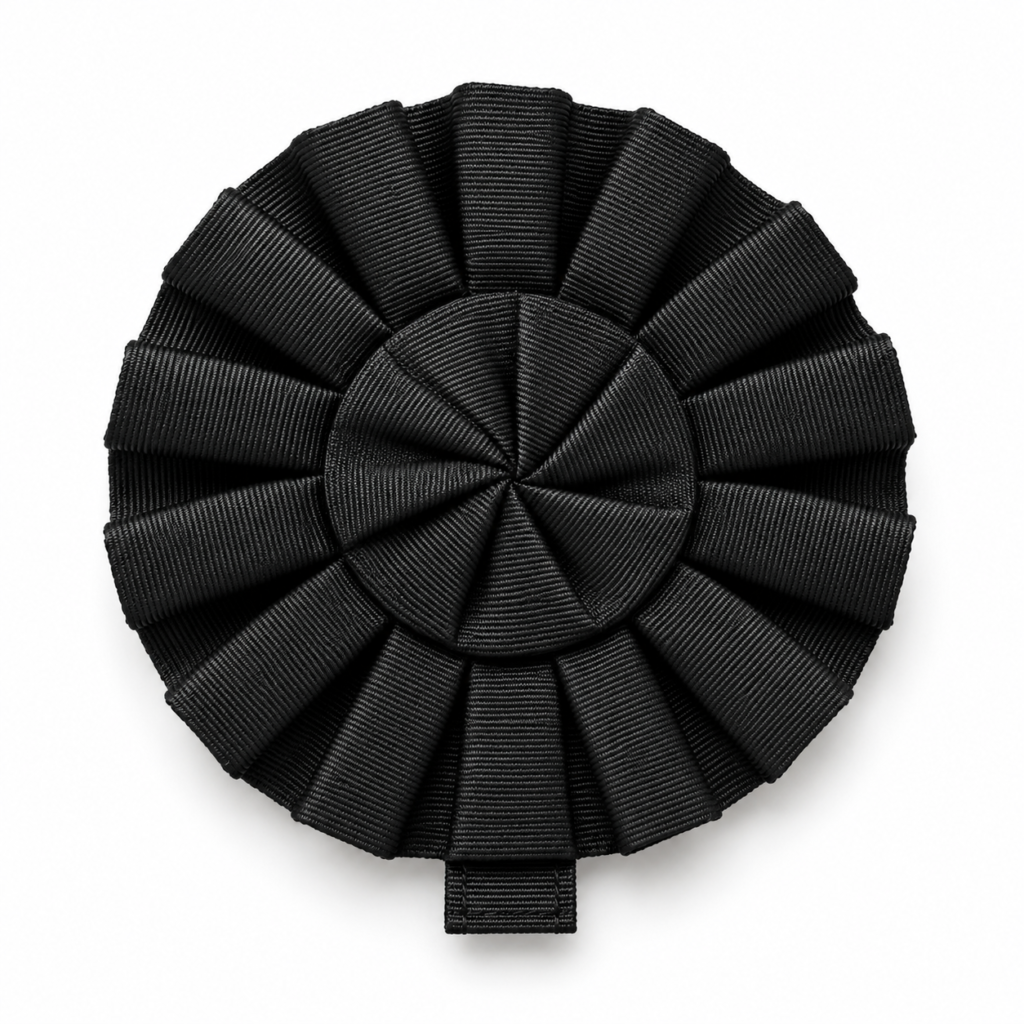
A bonnet cockade is one of the smallest parts of Highland dress, but making it well takes the same discipline as any larger garment: a clear brief, the right materials, a measurable specification, a real sample and a final check before dispatch. Most problems with cockades can be traced back to one of these steps being skipped.
Here is how ZESTLET approaches a bonnet cockade project, step by step, and what you as a buyer should check at each stage.
Step 1: Define the brief
Everything starts with what the cockade is for. The brief should cover the intended outfit or use, the bonnet style, the destination, the quantity by variant and an approved style reference. It should also say clearly which decisions are fixed and which are still open, especially diameter and ribbon.
Buyer check: does the brief say whether a badge will be fitted, and whether the cockades are supplied loose or fitted to bonnets?
Step 2: Choose ribbon, thread and backing
Next, the materials are compared: grosgrain or an alternative ribbon, the sewing thread and the backing. The accepted ribbon, color reference and backing are recorded, and specialist supply is confirmed before the design is treated as ready for production. For a colored or uniform range, this is where the physical shade reference becomes part of the file.
Buyer check: has a physical ribbon reference been agreed, not just a color name?
Step 3: Write a measurable specification
The design is turned into a drawing and a measurement and feature schedule: finished diameter, ribbon width, pleat count and shape, center type, backing, position on the bonnet and attachment method. Units, tolerances and the revision of any artwork are kept explicit, so everyone works from the same version.
Buyer check: every feature in the table below has a value, not “standard” or “as usual”.
Step 4: Fold and form the rosette
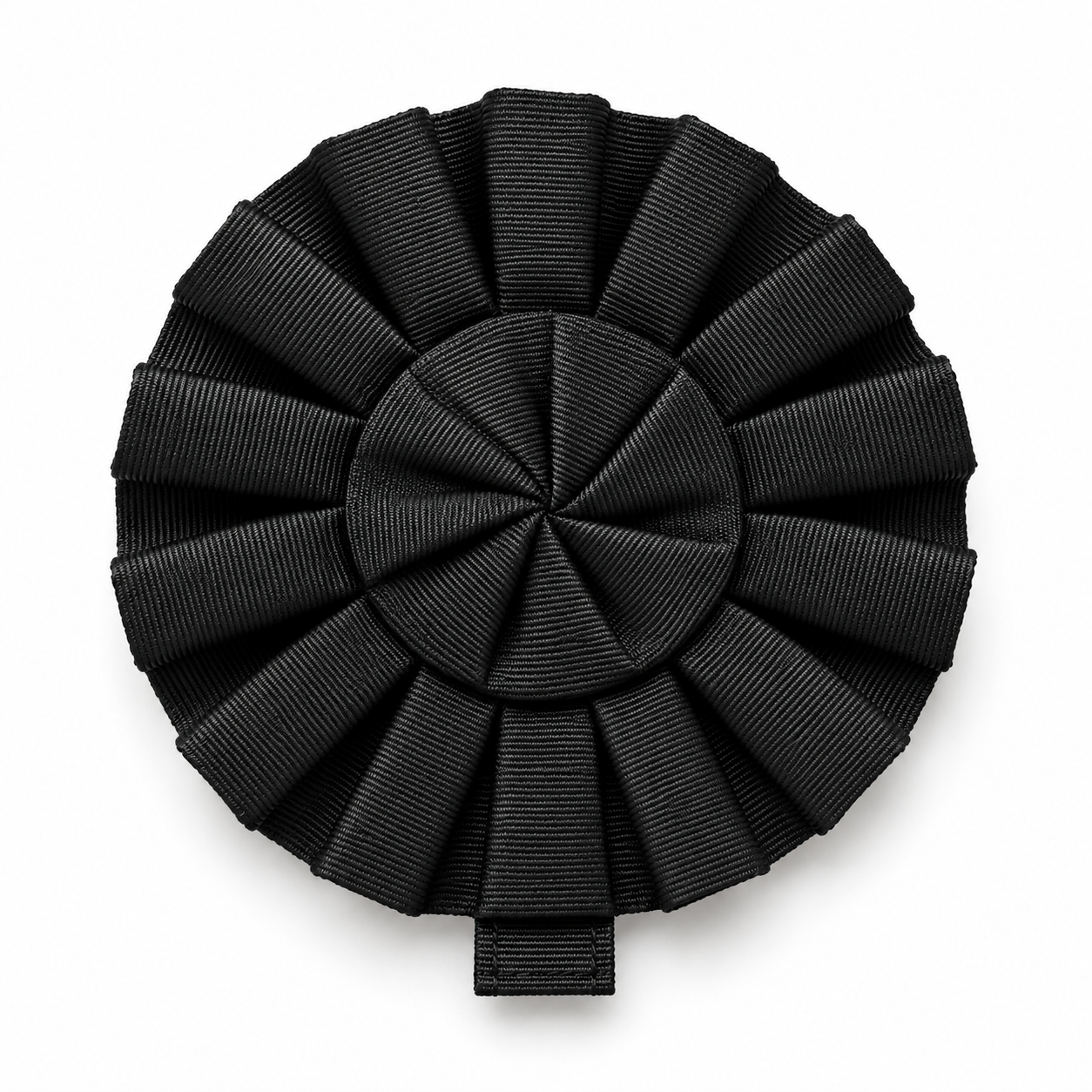
The ribbon is folded into the agreed number of pleats and formed into the approved shape, then secured so the folds stay even all round. Consistency here is what makes a batch of cockades look like a set rather than a collection of one-offs.
Step 5: Add the center and backing
The center is finished plain or with a badge-compatible opening, and the backing is added to support the folds and give a hidden, clean finish. Where a badge is used, the fixing clearance and support behind the center are built in at this stage.
Step 6: Review the real sample
A rosette that looks correct on its own may be too thick once a badge is attached. That is why the sample is reviewed in its real setting: on the intended bonnet, at the agreed position, with the badge if one is used. Changes are sent back as a numbered list against the current specification, not as general comments.
Step 7: Approve, then produce
Once the sample is right, the final reference, material list, dimensions, inspection criteria, labels and packing are confirmed, and a project-specific MOQ and schedule are agreed. Changes after approval can affect component availability and timing, so it pays to settle details at sample stage.
Step 8: Attach, inspect and dispatch
For fitted supply, cockades are stitched or fixed to the bonnets at the reference point. Finished goods are compared with the approved reference, counts by variant and included parts are confirmed, and the goods are packed so the folds are not crushed. Shipping documents and delivery terms are agreed for the actual destination.
Production checklist
| Stage | What is checked |
|---|---|
| Brief | Use, bonnet style, badge, quantities, loose or fitted |
| Materials | Ribbon type and width, shade reference, thread, backing |
| Specification | Diameter, pleat count, center, position, attachment, tolerances |
| Forming | Even folds, approved shape |
| Center and backing | Opening as ordered, firm support, hidden finish |
| Sample | Fit on bonnet, thickness with badge, shade in daylight |
| Bulk | Match to approved reference, counts, labels, protected packing |
For the decisions behind each step, see our bonnet cockade buyer’s guide, and for what goes wrong when steps are skipped, read common bonnet cockade problems. The cockade is one part of the bonnet, so you may also want to read how a balmoral bonnet is made.
Work with a maker who checks the small details
ZESTLET in Sialkot, Pakistan produces bonnet cockades and other Highland trims for outfitters, retailers and band suppliers.
- Measurable specification before any sample
- Sample reviewed on the bonnet and with your badge
- Small batches, sample first, private label welcome
- Inspection against the approved reference before dispatch
See the bonnet cockade product page or request a quote to start with a sample.
Frequently asked questions
Why is a sample needed for such a small part?
Size, thickness, shade and position only show their real effect on the bonnet. A sample lets you approve the cockade as it will actually be worn, including with the badge.
Can cockades be supplied already fitted to bonnets?
Yes, fitted trim or loose components can be discussed. Fitted supply needs an agreed position and attachment method in the specification.
What happens if I change the ribbon after approval?
Changes after approval can affect component availability and timing, so a new reference may need to be approved before production continues.
How are MOQ and lead time set?
They are confirmed per project after the specification and sample review, taking component minimums into account.
Can you work to my private label?
Yes. Labels and packing are agreed as part of the final approval, together with the reference sample.