
ZESTLET · OEM / ODM · Private Label
Compression Fabric Guide: Blends, GSM, Stretch and Flatlock Seams for Compression Wear
Build Now, Pay Later · New brands welcome
Launch your brand from 20 pieces. Pay the balance after your stock arrives.
ZESTLET makes your tactical, hunting, uniform and Highland products under your own label. Your first sample and branding setup are free, and orders from $5,000 can pay 60% after delivery.
Budget under $5,000
Startup Launch
- Start from 20 pieces per product
- Your first sample is free
- Labels, screens and digitising are free
- Bulk starts only after you approve the sample
Orders from $5,000
Build Now, Pay Later
- Pay 40% to start production
- Pay the other 60% monthly after delivery
- No interest and no application fee
- Your limit grows with every on-time payment
Your full journey with ZESTLET, step by step
From your first idea to stock in your warehouse. Every step is visible in your free brand dashboard.
- 1Create your free brand accountSign up in about one minute. We email you a 6-digit code to confirm your account.
- 2Check your credit in 30 secondsAnswer 3 short questions in your dashboard and see your pre-qualified credit limit straight away.
- 3Start your projectUpload your design or tech pack, choose the product and quantity. You can start from 20 pieces per product.
- 4Get your quotation within 24 hoursPrice per piece, lead time and payment terms in writing, from real people in Sialkot.
- 5Free sample with your brandingWe make your sample with your logo in 7–10 working days. You only pay the sample shipping.
- 6Approve and pay 40%Bulk production starts only after you approve the sample and pay the 40% deposit.
- 7Production and quality checksCutting, stitching, inspection and packing, with progress updates in your dashboard.
- 8Delivery, then pay 60% monthlyDoor-to-door shipping. Credit orders pay the balance after delivery over 90 to 365 days, with no interest.
What you need to apply
- Your brand name and contact details
- Your product idea, design or tech pack
- An order value from $5,000 for Build Now, Pay Later
- For higher limits: sales history or business registration
Your credit limit grows with you
First credit order
After 2 orders paid on time
After 4 cycles and a review
- Deposit
- 40%
- Balance after delivery
- 60%, monthly
- Repayment
- 90 to 365 days
- Interest and fees
- None
Can I start a clothing brand with a small budget?
Yes. You can start from 20 pieces per product, and your first sample and branding setup are free, so your budget goes into product.
Who can use Build Now, Pay Later?
Brands with orders from $5,000, including new brands with no sales history, after a short review. You pay 40% upfront and 60% in monthly instalments after delivery.
Is the sample free?
Yes, the first sample is made free with your branding. Sample shipping is paid by the buyer.
Credit is subject to approval. Amounts shown in your local currency are approximate.
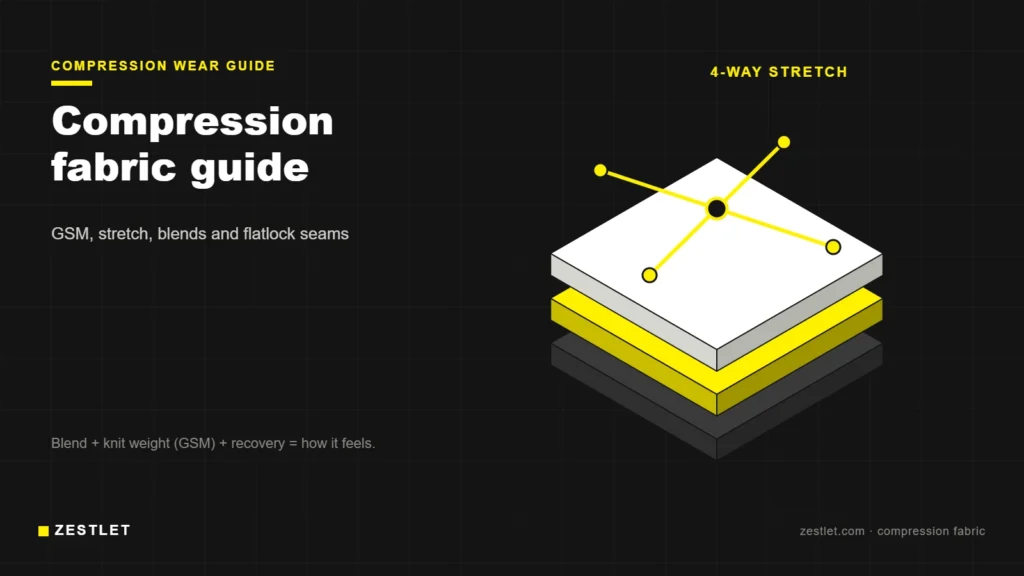
If you are building a compression line, whether that is training tops, base layers, running tights or medical-style compression soft goods, the fabric decides almost everything. It decides how tight the garment feels on day one, how it feels after fifty washes, whether it can be sublimated, and how much you pay per piece. This compression fabric guide walks through the decisions a brand has to make before it sends a tech pack to a compression shirt manufacturer: the blend, the knit weight (GSM), stretch and recovery, the seams and the tests that prove the fabric is right.
What makes a fabric a “compression” fabric?
Almost every compression garment is made from a warp or circular knit that contains elastane (also called spandex or Lycra, which is a brand name). The elastane gives the fabric stretch in both directions, and it pulls the fabric back to its original size when the tension is removed. The base yarn, usually nylon (polyamide) or polyester, gives the fabric its surface, its feel against the skin and most of its durability.
Three things separate real compression fabric from an ordinary stretch jersey:
- Higher elastane content. A fashion stretch tee might use 5% elastane. Compression fabrics usually run between roughly 12% and 25%.
- Power. The force the fabric needs to stretch. A compression fabric resists being stretched, which is what creates the pressure on the body.
- Recovery. After stretching it returns to its original length instead of growing. Poor recovery is the main reason cheap compression tops become loose after a few weeks.
Nylon/spandex vs polyester/spandex: which blend should you choose?
This is the first decision for any compression collection, and it affects price, printing and feel.

| Factor | Nylon / spandex | Polyester / spandex |
|---|---|---|
| Hand feel | Softer, smoother, cool touch | Drier and slightly crisper |
| Typical blend | 75-85% nylon, 15-25% spandex | 80-88% polyester, 12-20% spandex |
| Moisture | Absorbs a little more water | Wicks and dries quickly |
| Printing | Piece dyed, screen printed or heat transfer | Ideal for all-over sublimation prints |
| Abrasion | Excellent, good for contact sports and gym wear | Good; check the pilling grade |
| Cost | Higher | Lower to medium |
Choose nylon/spandex if…
- You sell premium training wear where the “second skin” feel is the selling point.
- Your designs are solid colours or use small logos, so you do not need full sublimation.
- Your customers train hard on rough surfaces (BJJ rash guards, rugby base layers) and abrasion matters.
Choose polyester/spandex if…
- You want all-over printed designs. Sublimation only works on polyester.
- Your price point is tight and you need a lower cost per unit.
- The garment is for running, cycling or outdoor use where fast drying matters most.
GSM: how heavy should compression fabric be?
GSM (grams per square metre) is the weight of the fabric. For compression it is a useful shorthand for thickness and support, but it is not the full story, because two fabrics of the same GSM can have very different power depending on how much elastane they contain.
| Use | Typical GSM range | Notes |
|---|---|---|
| Lightweight running and summer base layers | 150-190 | Breathable, light support, often mesh panels |
| Gym and training compression tops | 190-240 | The most common range for compression shirts |
| Compression tights and leggings | 220-280 | More coverage so the fabric does not show through when squatting |
| Rash guards and combat sports | 180-230 | Often polyester/spandex for sublimation |
| Brushed winter base layers | 220-300 | Brushed inner face adds warmth |
These are typical ranges, not rules. When you write your tech pack, specify a target GSM with a tolerance (for example 220 GSM ± 5%) and ask for the fabric test report before bulk cutting.
Stretch and recovery: the numbers that matter
Ask your fabric mill or manufacturer for stretch and recovery results for both length and width. For knitted fabrics the common method is ASTM D2594 (stretch properties of knitted fabrics with low power), and EN 14704-1 is also used. What you want to see:
- Stretch in both directions (“4-way stretch”), so the garment moves with the body.
- Low growth. Growth is how much longer the fabric stays after being stretched and released. Lower is better; high growth is what makes leggings bag at the knee.
- Consistency between lots. If you reorder, the new fabric lot should be tested again so your size chart stays true.
Seams: why flatlock matters on compression wear
Compression garments sit tight on the skin, so a raised seam that is fine on a hoodie will rub on a compression shirt during a long session. The seam type is as important as the fabric.

- Flatlock (ISO 4915 stitch class 607): four needles and six threads join the two edges side by side, so there is no ridge on the inside. Use it for side seams, sleeve seams, raglan seams and any seam that touches the skin under pressure.
- Overlock (514): a strong four-thread seam, but the edges overlap and leave a ridge. Fine for areas that do not rub, or for budget lines.
- Coverstitch (406): a two-needle stitch used for hems and bindings that must stretch with the fabric.
Two more construction details are worth adding to your tech pack: use a stretch thread (textured nylon or polyester) in the loopers so seams do not crack when stretched, and specify silicone gripper tape on hems of base layers and shorts so they do not ride up.
Tests to ask for before bulk production
A good manufacturer will arrange fabric and garment testing, either with the mill’s own certificates or an independent lab. For compression wear the useful tests are:
| Test | Common method | Why it matters |
|---|---|---|
| Stretch and recovery | ASTM D2594 / EN 14704-1 | Proves the fit stays true after wear |
| Pilling | ISO 12945-2 (Martindale) | Rubbing between arms and body |
| Colourfastness to perspiration | ISO 105-E04 | Sweat must not bleed dye onto skin or other clothes |
| Colourfastness to washing | ISO 105-C06 | Dark colours staying dark |
| Colourfastness to chlorinated water | ISO 105-E03 | Only for swim and pool use |
| Dimensional stability | ISO 5077 / ISO 6330 | Shrinkage after washing |
| UV protection (optional) | AS/NZS 4399 or AATCC 183 | If you claim UPF on outdoor base layers |
Only put a performance claim (UPF 50+, anti-odour, moisture-wicking) on your hangtag if a test report supports it.
Men’s compression clothing: fit and sizing tips
Men’s compression clothing is often sold on fit, so the size chart deserves as much attention as the fabric. A few practical rules we use when developing compression patterns:
- Negative ease. Compression patterns are cut smaller than the body. The amount depends on the fabric power, so the pattern must be made for the exact fabric you will use in bulk. Do not switch fabric after the fit sample is approved.
- Raglan or set-in sleeves. Raglan sleeves give more freedom for lifting and throwing; set-in sleeves look cleaner for lifestyle compression.
- Longer back length. Add length at the back so the top stays tucked when bending.
- Grade carefully. Stretch fabrics forgive small errors in one size and exaggerate them across a full size run. Check at least two sizes at the fit-sample stage.
Our fit sample approval guide explains how to review a sample and give clear comments to your factory.
Compression soft goods and medical-style compression
Search terms like “compression soft goods manufacturer” often come from brands making supports, sleeves, recovery wear or shapewear. These products use the same family of fabrics but usually with higher power and specific pressure targets. If your product makes a medical claim (for example graduated compression for circulation), it is regulated in many markets and needs pressure testing and documentation that a sportswear factory alone cannot provide. For sports and recovery products without medical claims, the process is the same as any other compression garment: fabric approval, pattern, sample, test, bulk.
How to brief a compression shirt manufacturer
When you send your first enquiry, these details will get you an accurate quote and a sample that fits:
- Product type and use (gym top, running base layer, rash guard, tights).
- Preferred blend and GSM, or a reference garment you like.
- Seam types (flatlock on all skin-contact seams).
- Decoration: sublimation, screen print, heat transfer, silicone print or embroidery.
- Size range and your size chart.
- Quantity per style and colour.
- Labels, hangtags and packaging.
A complete tech pack and a bill of materials make this much faster. If you do not have one yet, our team can help through tech pack and sampling.
Common compression wear problems and how to prevent them
| Problem | Usual cause | Prevention |
|---|---|---|
| Garment loosens after a few washes | Low elastane, poor recovery, washing too hot | Test recovery; specify cold wash and no tumble dry on the care label |
| Seams crack when stretched | Non-stretch thread, stitch too tight | Textured stretch thread in loopers; check seam stretch on the sample |
| Fabric shows through (see-through) when squatting | GSM too low, open knit | Heavier fabric for tights; do a squat test on the sample |
| Pilling under the arms | Spun yarns, low pilling grade | Filament yarns; ask for ISO 12945-2 result |
| Print cracks on stretch | Plastisol ink without stretch additive | Sublimation on polyester, or stretch inks and silicone prints |
| Hem rolls or rides up | No gripper, wrong hem stitch | Coverstitch hem with silicone gripper tape |
| Colour rubs off on skin | Poor fixation of dark dyes | Colourfastness to perspiration and rubbing tests |
What drives the cost of a compression shirt?
Two compression shirts that look the same can be priced very differently. The main cost drivers are:
- Fabric: nylon/spandex costs more than polyester/spandex, and branded elastane or recycled yarns add more. Fabric is usually the largest single cost.
- Elastane percentage and GSM: more spandex and heavier fabric mean more material cost.
- Seams: flatlock is slower to sew than overlock, so labour cost is higher.
- Panels: mesh ventilation panels, contrast sleeves and shaped side panels add cutting and sewing time.
- Decoration: full sublimation, reflective prints, silicone logos or embroidery each add a step.
- Quantity per colour: dyeing and printing have set-up costs, so small quantities per colour cost more per piece.
- Testing and packaging: lab reports, swing tags, polybags and retail boxes.
The easiest way to control cost without losing quality is to keep the fabric premium where it matters (the body) and simplify the extras: fewer panel colours, one decoration method and two or three colourways for the first drop.
Compression fabric checklist for your tech pack
- Blend with percentages (for example 80% nylon / 20% elastane)
- Knit type and target GSM with tolerance
- Required stretch and recovery, and the test method
- Finish: moisture management, anti-odour, brushed back (only if tested)
- Seam type per seam, stitch per inch and thread type
- Elastic, gripper tape, bindings and labels (heat-transfer labels avoid neck itch)
- Decoration method and placement
- Care instructions
Small-batch compression wear with ZESTLET
ZESTLET manufactures custom compression wear and activewear in Sialkot, Pakistan, for brands starting from small batches. We source nylon/spandex and polyester/spandex fabrics, sew skin-contact seams in flatlock, sublimate or print your designs, and arrange testing before bulk. You approve the fabric and the sample before we cut production. See our sportswear manufacturing guide or request a quote to start your compression line.
Frequently asked questions
What is the best fabric for compression shirts?
For premium training wear, a nylon/spandex blend of around 75-85% nylon and 15-25% spandex gives the softest feel and best abrasion resistance. For printed designs and lower cost, polyester/spandex is better because it can be sublimated.
What GSM is good for a compression shirt?
Most compression tops are made between about 190 and 240 GSM. Lighter fabrics suit running and hot weather; heavier, brushed fabrics suit winter base layers.
How much spandex should compression wear have?
Usually between 12% and 25%. More spandex means more stretch and power, but also higher cost and a warmer feel.
Why do compression shirts use flatlock seams?
Flatlock seams join fabric edges side by side with no ridge, so they do not rub the skin when the garment is tight and the wearer is moving.
Can compression wear be sublimation printed?
Yes, if the fabric is polyester/spandex. Sublimation does not work on nylon. For nylon compression use screen printing, heat transfer or silicone prints.
What is the minimum order for custom compression shirts?
It depends on the fabric and decoration. ZESTLET works with small batches; send your style and quantity through our quote form and we will confirm the minimum for your fabric.