ZESTLET · OEM / ODM · Private Label
How a Montrose Doublet Is Made: From Closed-Front Pattern to Final Inspection
Build Now, Pay Later · New brands welcome
Launch your brand from 20 pieces. Pay the balance after your stock arrives.
ZESTLET makes your tactical, hunting, uniform and Highland products under your own label. Your first sample and branding setup are free, and orders from $5,000 can pay 60% after delivery.
Budget under $5,000
Startup Launch
- Start from 20 pieces per product
- Your first sample is free
- Labels, screens and digitising are free
- Bulk starts only after you approve the sample
Orders from $5,000
Build Now, Pay Later
- Pay 40% to start production
- Pay the other 60% monthly after delivery
- No interest and no application fee
- Your limit grows with every on-time payment
Your full journey with ZESTLET, step by step
From your first idea to stock in your warehouse. Every step is visible in your free brand dashboard.
- 1Create your free brand accountSign up in about one minute. We email you a 6-digit code to confirm your account.
- 2Check your credit in 30 secondsAnswer 3 short questions in your dashboard and see your pre-qualified credit limit straight away.
- 3Start your projectUpload your design or tech pack, choose the product and quantity. You can start from 20 pieces per product.
- 4Get your quotation within 24 hoursPrice per piece, lead time and payment terms in writing, from real people in Sialkot.
- 5Free sample with your brandingWe make your sample with your logo in 7–10 working days. You only pay the sample shipping.
- 6Approve and pay 40%Bulk production starts only after you approve the sample and pay the 40% deposit.
- 7Production and quality checksCutting, stitching, inspection and packing, with progress updates in your dashboard.
- 8Delivery, then pay 60% monthlyDoor-to-door shipping. Credit orders pay the balance after delivery over 90 to 365 days, with no interest.
What you need to apply
- Your brand name and contact details
- Your product idea, design or tech pack
- An order value from $5,000 for Build Now, Pay Later
- For higher limits: sales history or business registration
Your credit limit grows with you
First credit order
After 2 orders paid on time
After 4 cycles and a review
- Deposit
- 40%
- Balance after delivery
- 60%, monthly
- Repayment
- 90 to 365 days
- Interest and fees
- None
Can I start a clothing brand with a small budget?
Yes. You can start from 20 pieces per product, and your first sample and branding setup are free, so your budget goes into product.
Who can use Build Now, Pay Later?
Brands with orders from $5,000, including new brands with no sales history, after a short review. You pay 40% upfront and 60% in monthly instalments after delivery.
Is the sample free?
Yes, the first sample is made free with your branding. Sample shipping is paid by the buyer.
Credit is subject to approval. Amounts shown in your local currency are approximate.
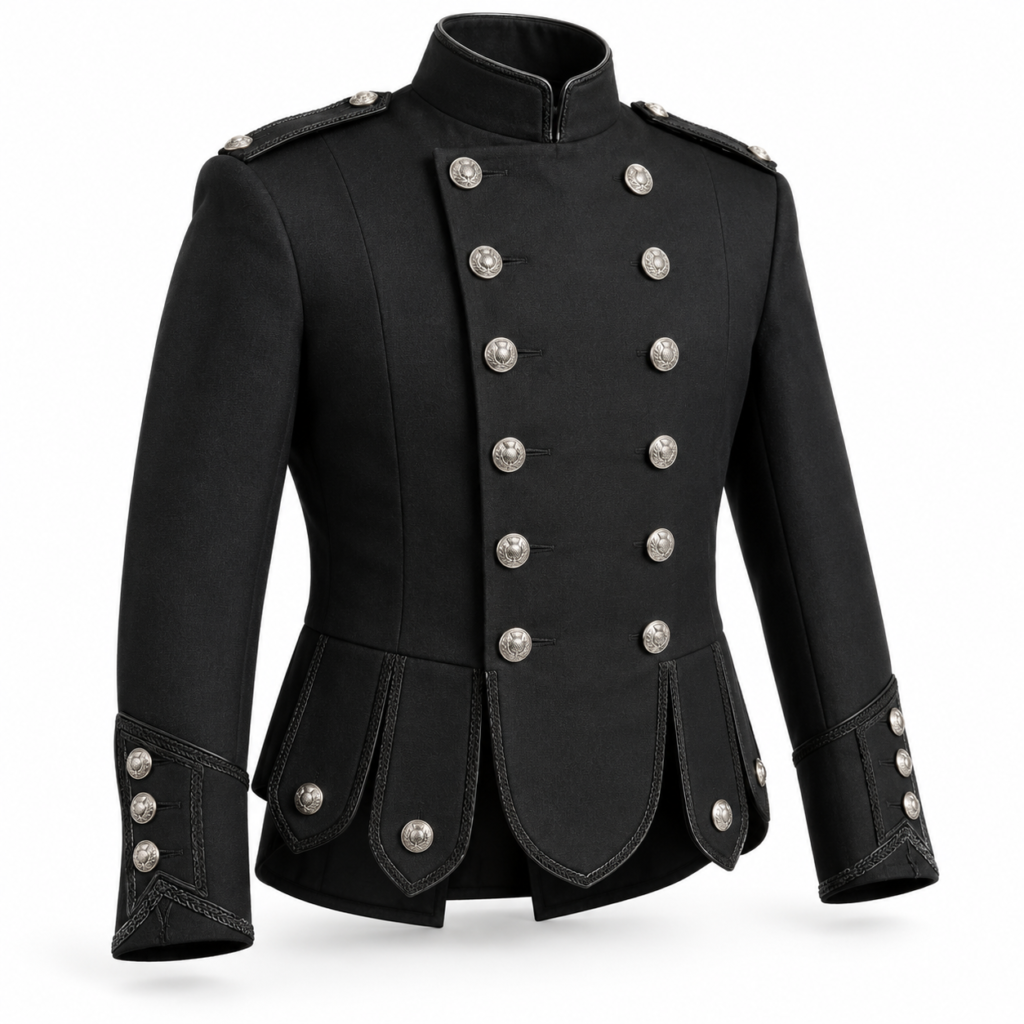
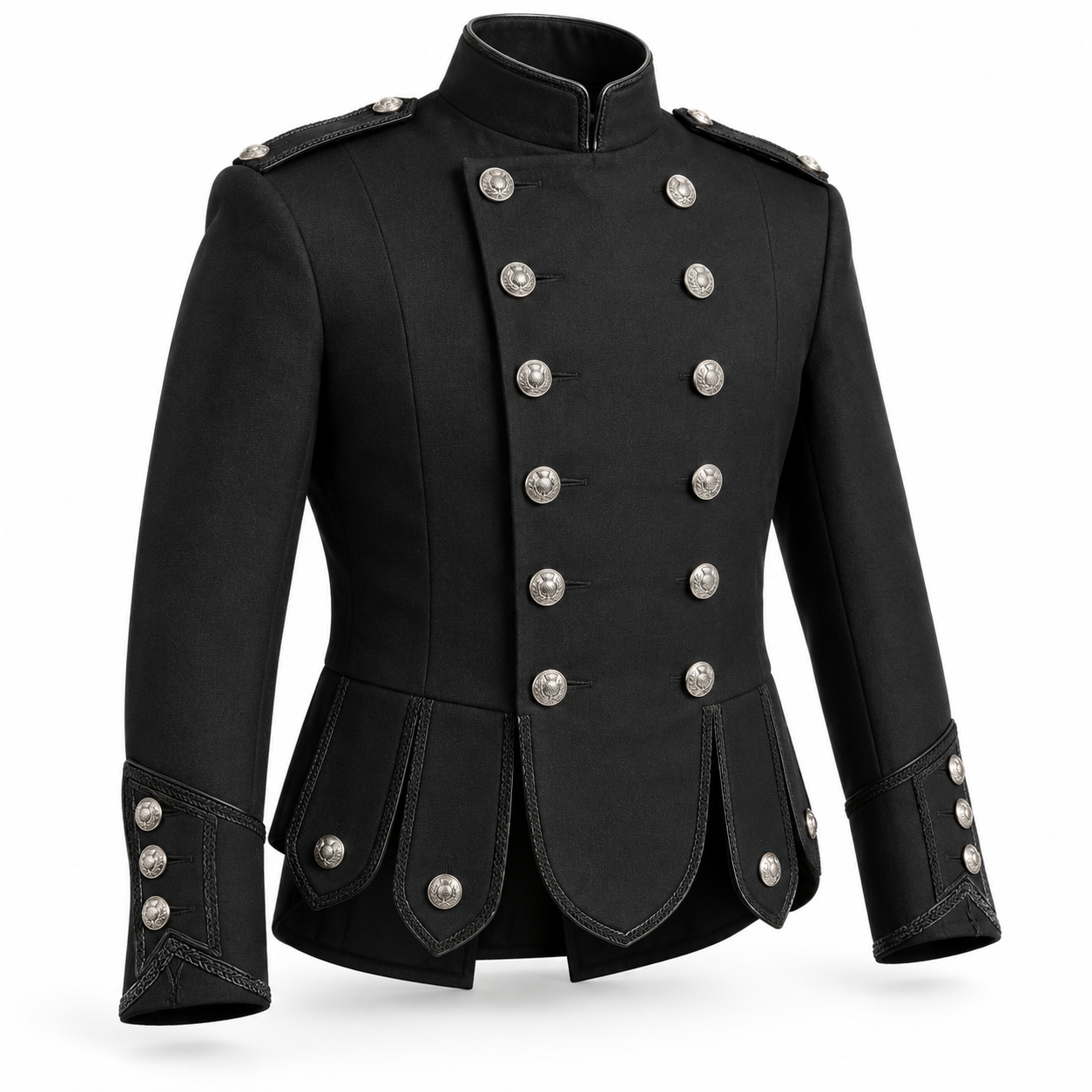
A Montrose doublet looks simple from a distance: a closed front, a high collar, two rows of buttons. Up close, it is a tailored garment where the overlap, the collar and the decorative skirt and cuffs all have to line up. Here is how ZESTLET takes a Montrose jacket from brief to finished garment, and what a buyer should check at each stage.
Step 1: Define the brief
Everything starts with the intended use, destination, quantity by size and the approved style reference. At this stage we separate what is fixed (for example, a band’s existing colour and button style) from what is still open, such as closure details, collar height or the cuff design.
Buyer check: is it clear whether the order is for retail, hire or a band, and which decisions are still open?
Step 2: Resolve cloth and components
Next we compare the cloth options: barathea-style cloth, velvet or a suitable alternative suiting. Lining, braid, buttons and any epaulette support are chosen at the same time, because they all affect weight and how the front sits. Specialist supply, such as a specific braid or button, is confirmed before the design is treated as ready for production.
Buyer check: are the accepted cloth, lining, braid and button references written down?
Step 3: Draft the pattern for a closed front
The pattern is drafted for a fastened, double-breasted front, not adapted from an open coatee. The overlap width, chest and waist ease, collar stand and skirt panel shape are set here. The specification drawing and measurement schedule cover button rows, skirt panels, cuffs and epaulettes, with units, tolerances and artwork revision stated.
Buyer check: do button spacing and row position have a tolerance on the drawing?
Step 4: Cutting
Panels are cut with attention to the cloth. Velvet must be cut with the pile running the same way on every panel, otherwise the shade changes between front, sleeves and collar. Collar and front interfacings are cut to support the standing collar and the overlap.
Step 5: Building the front and collar
The front panels are interfaced and shaped so the overlap lies flat when fastened. The standing collar is built with its support material and attached so it stands evenly on both sides. Buttonholes and button positions are marked from the pattern, not by eye, so both rows stay parallel.
Step 6: Skirt panels, cuffs and trim
Skirt panels are shaped and edge-finished, and braid is applied to cuffs and other decorated areas. Braid on curves needs care so it does not pucker. Epaulettes, where specified, are attached with their support and button position checked against the drawing.
Step 7: Lining, sleeves and finishing
Body and sleeve linings are set, sleeves attached and pressed. Pressing is done carefully on velvet to avoid crushing the pile. Buttons are sewn with the agreed shank so the closed front does not pull.
Step 8: Sample review
The first physical sample is the most important checkpoint. A closed front needs its own chest and waist ease; copying an open coatee’s measurements may restrict movement or leave the front gaping. The buyer reviews the sample fastened, standing and seated, with arms raised, and checks collar comfort and how the jacket sits over the kilt waistband.
Step 9: Grading, bulk and final inspection
Once the base size is approved, the pattern is graded and bulk production follows the approved sample. Final inspection compares finished jackets with the approved sample and specification before labelling, packing and dispatch.
Quality checkpoints at a glance
| Stage | What is checked |
|---|---|
| Brief | Use, destination, quantities, fixed and open decisions |
| Materials | Cloth, lining, braid and button references approved |
| Pattern | Closed-front ease, overlap, collar stand, tolerances |
| Cutting | Pile direction on velvet, matching panels |
| Assembly | Collar stands evenly, button rows parallel, braid flat on curves |
| Sample | Fit fastened, seated and moving, comfort at the collar |
| Final inspection | Match to approved sample, labels and packing |
To avoid the most common mistakes, read our Montrose jacket problems guide, and for cloth and measurement choices see the Montrose jacket buyer’s guide. The process for an open-front style is described in how a Prince Charlie jacket is made.
Develop your Montrose doublets with ZESTLET
ZESTLET in Sialkot, Pakistan develops Montrose jackets for Highland outfitters, retailers and pipe band suppliers, in barathea-style cloth, velvet or a suitable alternative suiting.
- Small batches with a project-specific MOQ
- Sample first, approved before bulk
- Private label with your labels and packing
See the Montrose Jacket or request a quote and send your brief.
Frequently asked questions
Where are ZESTLET Montrose jackets made?
In Sialkot, Pakistan, from an approved brief and sample.
Why is a physical sample needed?
The closed front, collar and braid only show their real fit and finish in the actual cloth. A rendering cannot show how the overlap sits or how the collar feels.
Can you work with my band’s existing buttons or braid?
Share the references and samples. Specialist components are confirmed before production, and their supply is planned for replacements.
How is velvet handled differently?
Velvet panels are cut with the pile in one direction and pressed carefully to avoid marks, so the shade looks even across the jacket.
How are MOQ and timing set?
Quantity, component minimums and schedule are confirmed after the specification review, because they depend on the cloth, trim and size range.