
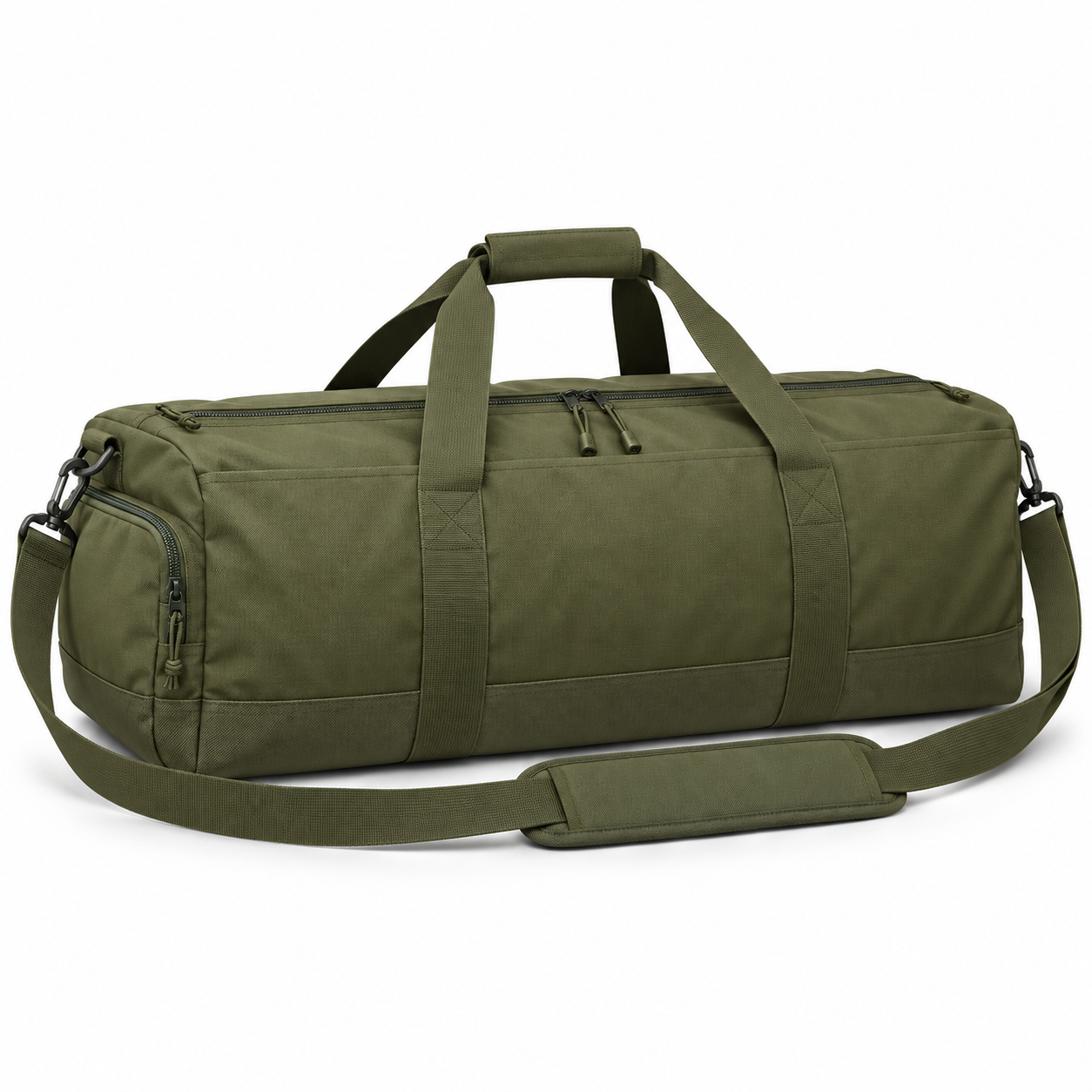
A large opening matters as much as a large body
Measure the biggest rigid item with its handles and protective case. Confirm it passes through the actual zipper opening; an internal dimension alone does not prove access.
OEM / ODM · Sialkot, Pakistan
ZESTLET in Sialkot, Pakistan reviews custom tactical duffel bag projects for brands, importers and equipment suppliers. A horizontal equipment holdall developed for organized kit transport, with a wide opening, agreed handle construction and protected base. Specify the items and handling routine before choosing dimensions or a claimed carrying capacity. Send a drawing, reference and quantity by variant for a project-specific manufacturing and sourcing review.
Specify a horizontal equipment holdall around opening clearance, handle load paths, base support and packed pocket space.
At a glance
Design and construction options are finalized against your approved tech pack and sample.
| Specification | Standard / design option | Customizable |
|---|---|---|
| Main dimensions | Finished length, width and height; empty and packed measurement conditions | To approved brief |
| Opening | U-shaped or straight zipper route and clearance for the largest item | To approved brief |
| Carry handles | Webbing route, grip length and joined-handle closure | To approved brief |
| Shoulder strap | Detachable or fixed arrangement with approved attachment hardware | To approved brief |
| End pockets | Separate external pocket depth and its effect on internal usable space | To approved brief |
| Base support | Flexible reinforcement or removable insert, with finish and edge protection | To approved brief |
| Organization | Removable dividers, shoe compartment or mesh pockets only as specified | To approved brief |
| Packing configuration | Folded or formed shipping condition and carton assortment | To approved brief |
| MOQ and schedule | Confirm by design, colour, material minimums and component availability | Project-specific |
| Branding and packing | Authorized artwork, label information and carton assortment approved before production | Project-specific |
ZESTLET in Sialkot, Pakistan reviews custom tactical duffel bag projects for brands, importers and equipment suppliers. A horizontal equipment holdall developed for organized kit transport, with a wide opening, agreed handle construction and protected base. Specify the items and handling routine before choosing dimensions or a claimed carrying capacity. Send a drawing, reference and quantity by variant for a project-specific manufacturing and sourcing review.
Measure the biggest rigid item with its handles and protective case. Confirm it passes through the actual zipper opening; an internal dimension alone does not prove access.
Trace how the handles connect to the body and base. Extra visible stitches in a small patch do not necessarily create the same load path as an approved continuous webbing arrangement.
A shoe or wet-item compartment occupies volume when filled. Review the final main-compartment space with that pocket loaded. A lining is not a tested leakproof barrier.
Material options describe development choices, not a fixed stocked specification. Review colour and handle in an actual swatch. Any water resistance, abrasion, load or chemical-resistance claim needs evidence for the applicable material or complete bag and defined test conditions.
| Property | Option / specification |
|---|---|
| Composition | Compare actual nylon or polyester fabric references, coating, backing and lining |
| Application | Main body, pockets and internal organization |
| Development considerations | Denier describes yarn size, not a complete strength or waterproof rating. Record weave, finish, supplier reference, colour and actual sample weight where required. Approve the finished panel with its seams and closures. |
| Property | Option / specification |
|---|---|
| Composition | Webbing, foam or spacer material, zipper, buckle and reinforcement selected by component reference |
| Application | Carry interfaces, contact areas, closures and load paths |
| Development considerations | Match strap width to buckle slots and agree slider retention, edge finish and stitch construction. Do not substitute a similar-looking buckle or foam without rechecking the assembly. Branded material or zipper names require genuine supplier confirmation. |
Agree a representative load, handling sequence and acceptance criteria before testing. Inspect attachment areas, seam distortion and hardware after the trial. No lifting or load rating is implied by “heavy duty”.
If a removable base is used, review corner shape, edge finish, access and cleaning. Check that it does not damage the lining or create a pressure point against the packed equipment.
Fill end pockets and the main cavity together. Confirm the main zipper closes without excessive force and that a shoulder strap can be attached without trapping a pocket or blocking retrieval.
Supply authorized artwork with dimensions and placement coordinates. Compare embroidery, a sewn label, print or a patch on the actual selected panel. Keep decoration clear of reinforced anchors and moving closures; a method suitable for one coating may not work on another.
Agree your item code, variant, material information, origin declaration and care instructions appropriate to the actual bag. Keep the artwork revision and bill of materials tied to the same approved sample. Do not add an unverified certification logo.
Specify hangtags, inserts, barcode artwork if supplied, individual protection and carton labels. If optional components are shown in marketing, distinguish included items from buyer-supplied equipment and confirm the final packing list.
Send your artwork (AI, PDF, PSD, PNG) and we return a digital mock-up before production.
Watch our hand-embroidery production reelConfirm the actual manufacturing and component-sourcing route for this tactical duffel bag before committing an order. The quotation should identify shell, lining, reinforcement, webbing, padding, closures and any removable parts. Approve alternatives individually, including their effect on dimensions and handling. A competitor’s branded fabric, delivery schedule or test claim is not a ZESTLET specification.
Identify the destination, intended users and intended use before finalizing materials, labeling and documentation. B2B buyers should provide their importer and retailer requirements for the exact program; a country name on an inquiry is not evidence of approval.
Use authorized logos and camouflage artwork. Declare actual material and origin accurately, and agree any destination-specific substance or labeling review for the configured product. No ballistic protection, official procurement approval, medical certification, waterproof rating or universal load capacity is claimed.
Agree dimensional tolerances, packed-access checks, seam and handle inspection, closure cycling and a suitable handling-load trial for this tactical duffel bag. State the sample size, conditioning and pass criteria before testing. If water, abrasion or cleaning performance will be advertised, agree an appropriate laboratory or specialist test and keep the report tied to the exact construction.
For UK, US, Canadian, Australian, New Zealand or other destination inquiries, state the market, intended use and buyer requirements. Confirm the actual material declaration, labeling, origin, artwork permission and any specialized import or event documentation before approving dispatch. A market name is not a certification or a promise of unrestricted availability.
Review your destination and documentation briefSend the intended use, quantity by variant, destination and a list of the objects carried. Add actual dimensions or physical references for rigid equipment. Mark included components separately from optional or buyer-supplied items.
Agree main dimensions, opening, carry handles, shoulder strap. Annotate the opening direction, compartment depth and measurement condition. A reference photo is a starting point; the approved drawing controls the final design.
Review actual swatches and component references, manufacturing responsibility and any specialist sourcing. Obtain a project-specific sampling scope, MOQ and schedule. Keep unresolved decisions visible in the brief rather than treating them as accepted facts.
Agree a representative load, handling sequence and acceptance criteria before testing. Inspect attachment areas, seam distortion and hardware after the trial. No lifting or load rating is implied by “heavy duty”. Give one numbered change list against the current sample revision, including dimensions and photographs where useful.
Sign off the final reference, bill of materials, artwork, tolerances, inspection criteria and packing plan. Reconfirm the schedule after any material or layout change. Retain one reference for repeat-order comparisons.
Verify counts and variants, compare finished goods with the approved reference and check closure and strap operation. Agree shipment documents and delivery terms for the actual destination, with each included insert or accessory listed.
Pack the tactical duffel bag in an agreed folded or formed condition that protects straps, buckle edges and shaped panels. Identify each colour, size or layout variant on the receiving label. List removable parts and their quantities, and keep loose accessories from scratching clear panels or hardware. Agree unit protection, carton assortment, carton dimensions and dispatch paperwork before production; freight terms and duties must be confirmed for the actual shipment.
Both spellings are commonly used for this style of holdall. The quotation should identify the same item code, drawing and specification regardless of spelling.
Discuss a specific conversion system with stowable straps and suitable body support. It is a separate development choice, not included merely because the bag has two carry handles.
No universal airline approval is claimed. Supply the airline and travel requirements, compare their current size rules and check the packed dimensions of the approved sample.
Water protection depends on the complete construction, seams, closures and test conditions. Agree the required test and evidence for the finished bag rather than inferring waterproofing from a coated base fabric.
Send the intended use, carried-item list, dimensions, opening and pocket layout, material preferences, authorized artwork, quantity by colour and destination. Include the required sample checks and mark any unanswered decisions so the team can review feasibility before quoting.
Both are confirmed for the actual bag after its materials, component minimums and customization scope are reviewed. A general website starting MOQ does not automatically apply to every fabric colour, molded part or sourced component. Obtain written sampling and bulk schedules.
Yes, request an actual sample of the configured design. ZESTLET’s published general policy describes free sampling with buyer-paid shipping; confirm what applies to new patterns, tooling and specialist or sourced components. Approve the final packed layout and materials before bulk release.
Discuss private labels, authorized logo application, hangtags and packing. Approve the method on the selected fabric and retain the exact artwork revision. A custom logo does not establish ownership of another brand’s design or license its proprietary materials.
Start your development
Request a quotation, free sample or fabric swatches. Sample shipping is paid by the buyer.
Contact: ZESTLET Sales Team · Sialkot, Pakistan · sales@zestlet.com · +92 329 4213122
Last updated:
ZESTLET office and contact details