ZESTLET · OEM / ODM · Private Label
French Terry vs Brushed Fleece: Choosing Hoodie Fabric and GSM for Your Brand
Build Now, Pay Later · New brands welcome
Launch your brand from 20 pieces. Pay the balance after your stock arrives.
ZESTLET makes your tactical, hunting, uniform and Highland products under your own label. Your first sample and branding setup are free, and orders from $5,000 can pay 60% after delivery.
Budget under $5,000
Startup Launch
- Start from 20 pieces per product
- Your first sample is free
- Labels, screens and digitising are free
- Bulk starts only after you approve the sample
Orders from $5,000
Build Now, Pay Later
- Pay 40% to start production
- Pay the other 60% monthly after delivery
- No interest and no application fee
- Your limit grows with every on-time payment
Your full journey with ZESTLET, step by step
From your first idea to stock in your warehouse. Every step is visible in your free brand dashboard.
- 1Create your free brand accountSign up in about one minute. We email you a 6-digit code to confirm your account.
- 2Check your credit in 30 secondsAnswer 3 short questions in your dashboard and see your pre-qualified credit limit straight away.
- 3Start your projectUpload your design or tech pack, choose the product and quantity. You can start from 20 pieces per product.
- 4Get your quotation within 24 hoursPrice per piece, lead time and payment terms in writing, from real people in Sialkot.
- 5Free sample with your brandingWe make your sample with your logo in 7–10 working days. You only pay the sample shipping.
- 6Approve and pay 40%Bulk production starts only after you approve the sample and pay the 40% deposit.
- 7Production and quality checksCutting, stitching, inspection and packing, with progress updates in your dashboard.
- 8Delivery, then pay 60% monthlyDoor-to-door shipping. Credit orders pay the balance after delivery over 90 to 365 days, with no interest.
What you need to apply
- Your brand name and contact details
- Your product idea, design or tech pack
- An order value from $5,000 for Build Now, Pay Later
- For higher limits: sales history or business registration
Your credit limit grows with you
First credit order
After 2 orders paid on time
After 4 cycles and a review
- Deposit
- 40%
- Balance after delivery
- 60%, monthly
- Repayment
- 90 to 365 days
- Interest and fees
- None
Can I start a clothing brand with a small budget?
Yes. You can start from 20 pieces per product, and your first sample and branding setup are free, so your budget goes into product.
Who can use Build Now, Pay Later?
Brands with orders from $5,000, including new brands with no sales history, after a short review. You pay 40% upfront and 60% in monthly instalments after delivery.
Is the sample free?
Yes, the first sample is made free with your branding. Sample shipping is paid by the buyer.
Credit is subject to approval. Amounts shown in your local currency are approximate.
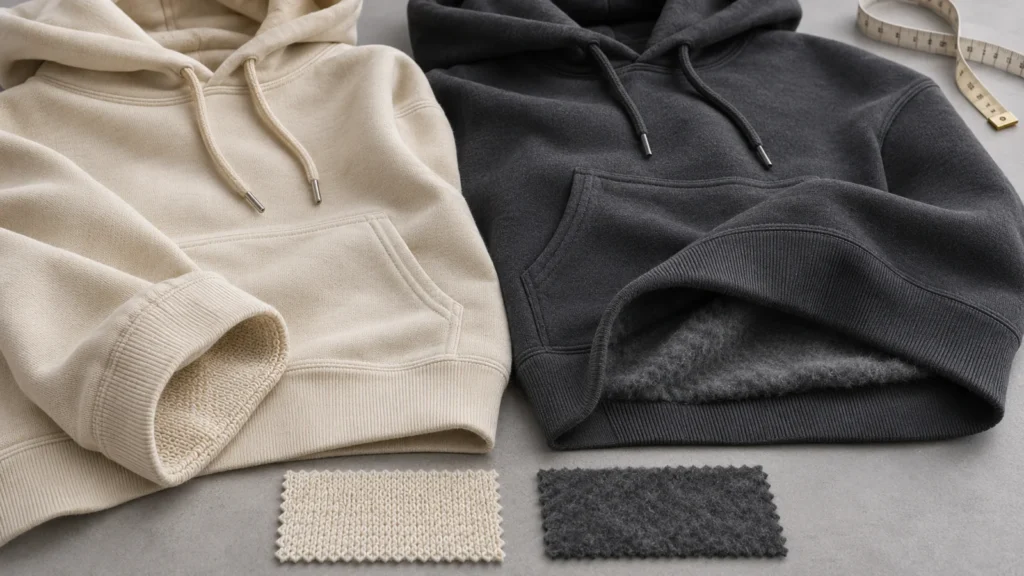
Choosing between French terry and brushed fleece is a product-development decision, not simply a choice between two fabric names. For a clothing brand, the right answer depends on the intended season, the silhouette, the inside feel, the surface needed for decoration and the result after washing. A heavier fabric can still be wrong for the design, while a lighter fabric can be right for the customer and climate.
This guide explains what to put in a fabric brief, how to compare swatches fairly and what to approve before placing a custom hoodie order. It covers sweatshirt fleece rather than polyester polar fleece or sherpa, which should be specified separately.
French terry vs brushed fleece: the practical difference
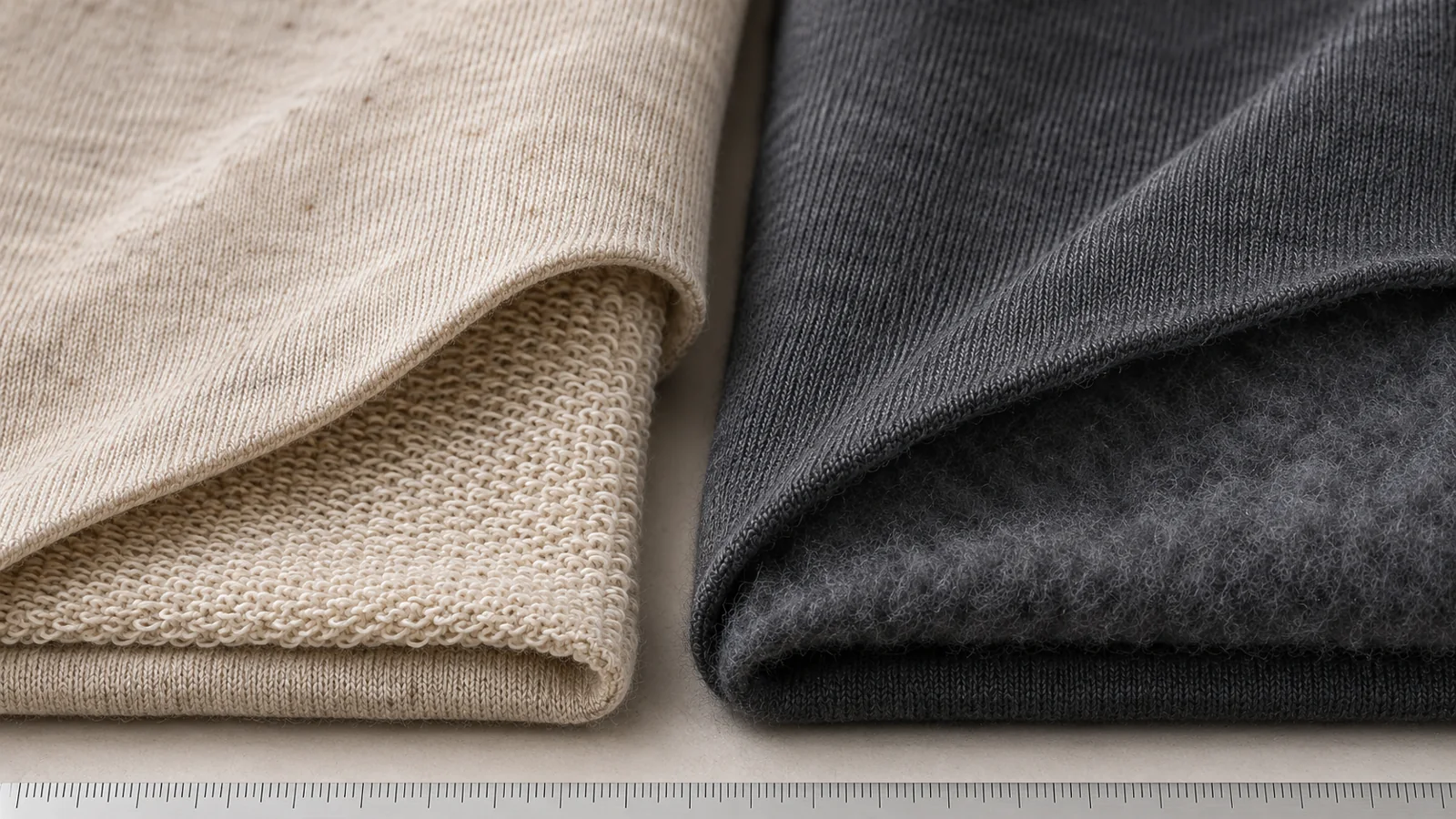
Look at the reverse side. French terry normally has visible, unbrushed loops. Brushed sweatshirt fleece has a raised, fuzzy reverse produced by napping the backing yarns. CottonWorks describes these as related knit constructions and notes that fleece can use cotton, cotton blends or synthetic fibres. Neither name, on its own, tells a buyer the exact composition or weight.
| Buying question | French terry | Brushed sweatshirt fleece |
|---|---|---|
| What should the reverse look like? | Defined, unbrushed loops | A raised, brushed surface |
| What should a sample review focus on? | Loop consistency, drape and feel against the skin | Brushing consistency, surface appearance and feel after washing |
| What needs a separate specification? | Composition, GSM, width, colour and finishing | Composition, GSM, width, colour and degree of brushing |
| Can either make a premium hoodie? | Yes, when it suits the design and approved quality brief | Yes, when it suits the design and approved quality brief |
For a trans-seasonal collection, start by comparing a loopback sample with the intended layering pieces. For a cosy cold-weather product, include a brushed option in the same fitting review. Treat these as development directions rather than automatic warmth or breathability ratings: the finished fabric and garment need to support any performance claim.
What GSM means when you order hoodie fabric
GSM means grams per square metre: the mass of a measured area of fabric. It is not the total weight of a hoodie and it is not a quality grade. Two fabrics with the same GSM can differ in thickness, stretch, density, drape and handfeel. A double-layer hood, larger size or oversized fit also changes the finished garment weight without changing the body fabric GSM.
For a first sampling round, a brand might request a 300 GSM French terry and a 340 GSM brushed fleece. Those are example development targets, not universal seasonal rules. Compare them in the intended silhouette and specify that the quoted weight refers to the finished fabric. Record the agreed tolerance and the condition in which weight is assessed, rather than relying on a rounded number in a sales message.
A useful brief also says whether the garment will be washed or dyed after sewing. Request the relevant fabric and finished-garment samples so that approval is based on the product the buyer will receive.
Composition and construction belong in the same brief
A request for “heavy cotton fleece” leaves too much room for different interpretations. State the full fibre percentages and identify the surface that matters for your artwork. Ask the supplier to confirm the face and backing construction instead of assuming every cotton-rich knit has the same print surface.
Keep stretch and recovery in the brief if they affect the fit. The waistband and cuffs deserve their own rib specification; they do not have to use the same construction or composition as the body. Review rib width, finished cuff opening, recovery after stretching, colour match and the way the waistband holds the intended silhouette.
Compare complete hoodie samples, not isolated swatches alone
Swatches are useful for narrowing a shortlist. They cannot show whether a hood collapses, whether a pocket pulls the front down or whether a thick seam is uncomfortable. Use a consistent reference size and measurement sheet when comparing the final two options. Keep the main dimensions and pattern intent the same so the team can identify which differences come from fabric.
Check the hoodie standing, sitting and with the arms raised. Record the shoulder line, sleeve volume, hood balance, pocket position and hem behaviour. Photograph the approved fit for internal reference and attach written comments to a dated sample record. Approve the physical garment rather than making the final decision from a fabric name or an image alone.
Wash testing: shrinkage, twisting and surface appearance
Knitted garments can change dimensions during laundering. CottonWorks identifies construction, processing tensions, finishing and care as contributing factors. Relaxation and compaction can reduce residual shrinkage, but “pre-shrunk” should not replace an agreed measurement and care procedure.
Write down the proposed care instructions, number of wash cycles, measurement points and acceptance limits. Measure the same garment before and after the agreed procedure. Compare body length, chest width, sleeve length and hem width, and inspect side-seam alignment. A sample that feels excellent before washing may still need development if the approved fit changes too much afterwards.
Pilling also deserves a separate requirement. Fibre choice, yarn, construction and finishing can influence it; composition or GSM alone cannot guarantee a result. Ask for the relevant test method and acceptance level for your product. A home-wash sample review is useful for development, but should not be described as a laboratory test.
Printing, embroidery and garment finishing
Approve decoration on the actual fabric and colour. Send artwork dimensions, placement, colour references and the intended decoration process. Ask for a decorated sample to inspect print feel, coverage, embroidery distortion and any marks from processing. Include the wash review when judging the finished artwork.
If a washed or worn-in appearance is part of the design, agree a physical reference and a reasonable appearance range. Avoid approving a finish through a colour name alone. Confirm whether the sample uses the same fabric and finishing route proposed for bulk, and resolve substitutions before approval.
A hoodie fabric RFQ checklist you can send to a manufacturer
- Product: pullover or zip hoodie, intended season, customer and reference fit.
- Body fabric: French terry or brushed sweatshirt fleece, with full fibre percentages.
- Finished GSM target and agreed tolerance; usable fabric width for costing.
- Colour standard, dyeing route, washing treatment and inside finish.
- Rib composition, width, recovery and colour-matching requirements.
- Size chart, construction details, hood layers, pocket and seam requirements.
- Artwork files, decoration method, dimensions and placement measurements.
- Care procedure, dimensional-change limits, pilling requirements and agreed testing.
- Order quantities by style, colour and size, plus labels and packaging.
- Sample approval process, production timing and shipping destination.
For a complete handover, use a tech pack and sampling brief. Compare related custom streetwear hoodie development and private-label sweatshirt options before finalising the range.
Frequently asked questions
Is French terry always lighter than fleece?
No. Both are available in different weights. Compare the finished GSM, construction and sample rather than treating the fabric name as a weight specification.
Does a higher GSM automatically mean better quality?
No. Quality is the match between the approved brief and the delivered product. Fit, construction, finishing, consistency and wash performance matter alongside fabric weight.
Which is better for a first hoodie collection?
Choose the material that meets your customer, climate and product brief after sampling. If uncertain, compare one French terry and one brushed-fleece option in the same reference size before committing to bulk.
Develop your hoodie with ZESTLET
ZESTLET develops custom clothing in Sialkot, Pakistan, for OEM, ODM and private-label projects. Send your design, preferred fabric, GSM direction, size range and quantities for a project-specific review. Small-batch production starts from 20 pieces per style and colour, with material availability and the final specification confirmed in your quotation. Request a manufacturing quote and approve the physical sample before production.
Technical references
- CottonWorks: Single & Double Knits — French terry and sweatshirt fleece construction.
- CottonWorks: Mechanical Finishing — relaxation and compaction.
- CottonWorks: Shrinkage & Skewing — factors affecting dimensional stability.
- CottonWorks: Garment Durability — pilling and buyer–supplier performance agreements.