ZESTLET · OEM / ODM · Private Label
How to Start a Clothing Line: Product Brief, Costs and First-Run Decisions
Build Now, Pay Later · New brands welcome
Launch your brand from 20 pieces. Pay the balance after your stock arrives.
ZESTLET makes your tactical, hunting, uniform and Highland products under your own label. Your first sample and branding setup are free, and orders from $5,000 can pay 60% after delivery.
Budget under $5,000
Startup Launch
- Start from 20 pieces per product
- Your first sample is free
- Labels, screens and digitising are free
- Bulk starts only after you approve the sample
Orders from $5,000
Build Now, Pay Later
- Pay 40% to start production
- Pay the other 60% monthly after delivery
- No interest and no application fee
- Your limit grows with every on-time payment
Your full journey with ZESTLET, step by step
From your first idea to stock in your warehouse. Every step is visible in your free brand dashboard.
- 1Create your free brand accountSign up in about one minute. We email you a 6-digit code to confirm your account.
- 2Check your credit in 30 secondsAnswer 3 short questions in your dashboard and see your pre-qualified credit limit straight away.
- 3Start your projectUpload your design or tech pack, choose the product and quantity. You can start from 20 pieces per product.
- 4Get your quotation within 24 hoursPrice per piece, lead time and payment terms in writing, from real people in Sialkot.
- 5Free sample with your brandingWe make your sample with your logo in 7–10 working days. You only pay the sample shipping.
- 6Approve and pay 40%Bulk production starts only after you approve the sample and pay the 40% deposit.
- 7Production and quality checksCutting, stitching, inspection and packing, with progress updates in your dashboard.
- 8Delivery, then pay 60% monthlyDoor-to-door shipping. Credit orders pay the balance after delivery over 90 to 365 days, with no interest.
What you need to apply
- Your brand name and contact details
- Your product idea, design or tech pack
- An order value from $5,000 for Build Now, Pay Later
- For higher limits: sales history or business registration
Your credit limit grows with you
First credit order
After 2 orders paid on time
After 4 cycles and a review
- Deposit
- 40%
- Balance after delivery
- 60%, monthly
- Repayment
- 90 to 365 days
- Interest and fees
- None
Can I start a clothing brand with a small budget?
Yes. You can start from 20 pieces per product, and your first sample and branding setup are free, so your budget goes into product.
Who can use Build Now, Pay Later?
Brands with orders from $5,000, including new brands with no sales history, after a short review. You pay 40% upfront and 60% in monthly instalments after delivery.
Is the sample free?
Yes, the first sample is made free with your branding. Sample shipping is paid by the buyer.
Credit is subject to approval. Amounts shown in your local currency are approximate.
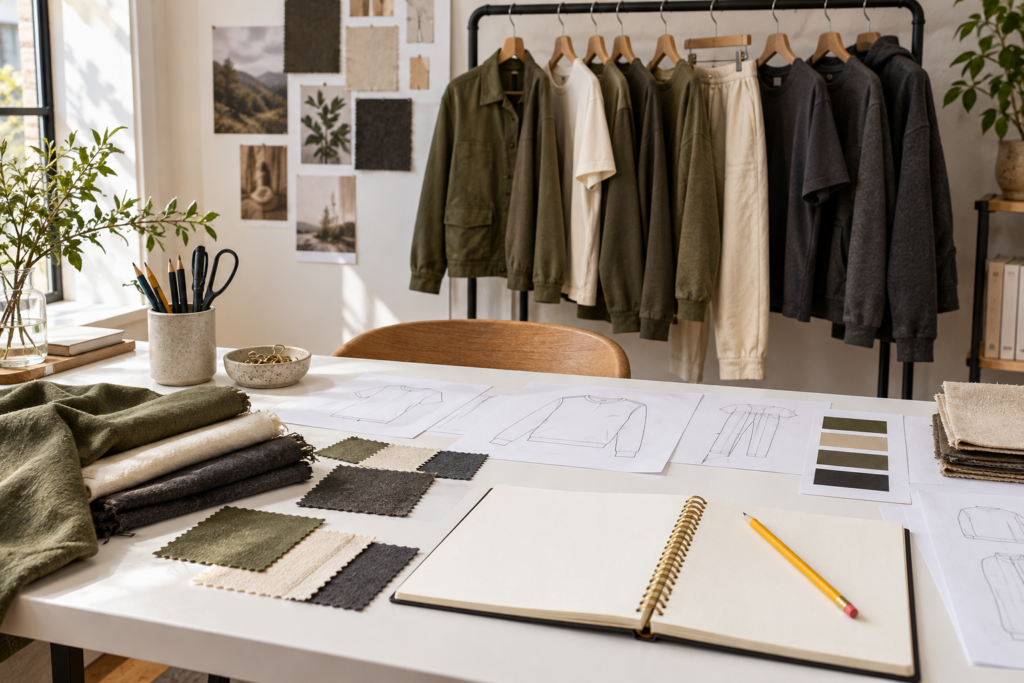
Start a clothing line by defining a customer problem, choosing a focused first product and testing the actual garment before committing to a broad range. Build the product brief, development plan and complete cost picture together. A name and logo can express a brand, but they do not establish that its garment fits the intended wearer or can be produced at the required specification.
This guide is for founders planning an original or private label apparel range. It provides a decision sequence rather than a promise of sales, profit or a fixed launch budget. The right plan depends on the product, market and work you can support.
Define the wearer and the reason to choose your product
Write a short description of the customer, intended use and purchasing situation. Explain which problem the garment addresses: fit, pocket organization, outfit coordination, material preference or another identifiable need. Keep the claim narrow enough that a sample and customer discussion can help evaluate it.
Talk to prospective customers and compare the alternatives they already use. Ask what works, what causes difficulty and how they choose between products. The U.S. Small Business Administration recommends combining customer research with competitive analysis; for an apparel founder, this means testing assumptions beyond whether someone likes a proposed logo.
Choose a first range you can explain and control
List the proposed styles, colors and sizes. Give every variant a reason to exist. A focused launch can make fit feedback and stock allocation easier to interpret than a large collection of unrelated garments. Focus does not mean omitting sizes your target customer needs; it means avoiding variation without a clear purpose.
Separate the core product from later ideas. If the first garment succeeds on its intended terms, you can use actual feedback to decide the next development step. Do not treat an extensive mood board as an instruction to manufacture every item at once.
Translate the idea into a reviewable product brief
| Decision | What to prepare | What remains to approve |
|---|---|---|
| Design | Authorized references and garment views | Construction and feature relationships |
| Fit | Target wearer, size range and measurement method | Physical sample and size-range review |
| Materials | Required characteristics and available references | Actual fabric, trims and assembled result |
| Branding | Logo files, label information and placement | Artwork proof and application sample |
| Order | Quantities, destination and delivery expectations | Project quotation and commercial terms |
If you do not have technical drawings or patterns, state that clearly. Ask the development provider to define what it will prepare, which files you receive and how revisions are handled. A useful tech pack connects the design to measurable instructions instead of hiding open decisions behind attractive renderings.
Build the cost picture before selecting the production quantity
List development, samples, materials, garment production, decoration, labels, packing and the agreed delivery basis. Add the business activities needed to present and sell the product, such as photography and the sales channel. Identify which costs occur once, which recur and which depend on the final specification.
The SBA’s startup planning resources distinguish initial and continuing expenses. Apply that distinction to your own quotes rather than adopting a generic online budget as a fact about your launch. Review destination duties, taxes, business requirements and contractual questions with suitable current professional guidance.
Compare quantity scenarios against the same product specification. Ask what the minimum applies to and whether materials or packaging require a separate purchase. A lower unit price can require a larger total commitment, so compare the complete plan and inventory implications.
Use samples to resolve the most important uncertainties
Decide what each sample is meant to prove. An early prototype may investigate silhouette or assembly, while another review confirms the actual material and branding. Identify substitutes so an early sample is not mistaken for a final approved product.
Review the garment in its intended use and keep numbered comments. Separate a defect against the current instruction from a new design decision. When a change is accepted, update the drawing, measurements and material list together. Keep the accepted sample reference with the current files.
Prepare the selling information from the approved product
Build product descriptions, size information and photographs around what you have actually approved. Explain included pieces and optional accessories. Avoid technical, origin or certification claims that cannot be supported for the exact item.
Keep an item code and variant identifiers consistent across the garment, packaging, website and order records. This makes receiving goods, answering customer questions and interpreting early feedback more reliable. For wholesale selling, prepare a controlled line sheet rather than asking retailers to infer order details from lifestyle photographs.
Define what the first run will teach you
Choose practical review points before launch: fit comments by size, questions buyers repeatedly ask, which variants receive committed orders and whether the supplied garments match the accepted reference. Keep the information linked to the product and revision.
Review the result before ordering a wider range. A weak result might concern the product, presentation, allocation or sales channel, and those require different responses. Do not automatically solve every problem by adding more colors or ordering more stock.
Clothing-line launch questions
Do I need a complete collection first?
No universal range size is required. Start with a scope you can develop, approve and support. Explain why each style and variant belongs in the launch.
Can I begin without manufacturing knowledge?
You can seek development support, but define deliverables and approval responsibilities clearly. Learn enough about the specification to evaluate proposals and recognize unresolved questions.
What should I send ZESTLET?
Share your intended customer, garment reference, quantities, destination and current development stage through our private label service. Exact capability, materials, minimums and schedules are confirmed for the actual design.
Sources and related guidance
Background: U.S. SBA business planning resources. The garment-development sequence is original ZESTLET editorial guidance. Continue with MOQ planning, small-batch planning and manufacturer selection.